

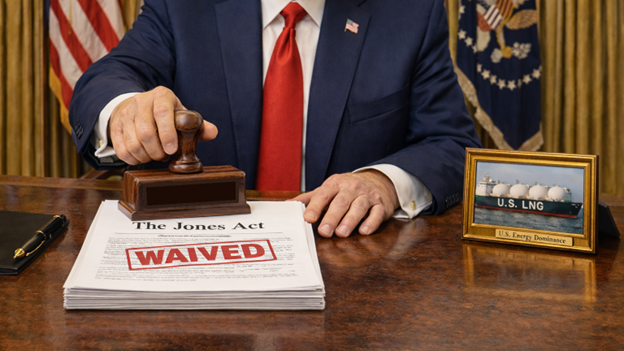
Key Question in an Energy Emergency
Q: Could a President simply waive the Jones Act to rush energy (oil, refined products, fuels, LNG) to constrained markets like California, the Northeast, Hawaii, Puerto Rico, Guam, et al?
A (short version): Yes. And No. Though a panacea it is not.
So, then what could he do that would be effective?
Firstly, what is the JONES ACT?
The Jones Act (46 U.S.C. § 55102) is part of U.S. maritime law governing the “coastwise trade”, which refers to the transportation of goods between domestic ports. The law ensures that only vessels wholly owned by U.S. citizens and issued a certificate of documentation with a coastwise endorsement (or eligible for one) may transport merchandise (including crude oil, gasoline, diesel, jet fuel, LNG, or any other “merchandise”) between U.S. points, including inland waterways, territorial seas, and non-contiguous territories such as Puerto Rico, Guam, and Hawaii. In practical terms, that means only ships that are constructed in American shipyards, owned and managed mostly by U.S. citizens, and operated under the U.S. flag with American crews are legally allowed to move energy products from one U.S. port to another. [Legal Definitions]
The statute is designed to protect the American maritime industry and ensure a domestic fleet exists for national defense. Violations can trigger severe penalties, including seizure of the cargo or fines equal to the cargo’s value or the cost of transportation. [Legal Information Institute]
But it also limits the number of eligible ships — making U.S.–to–U.S. marine transport expensive and sometimes impossible for products like LNG (because no Jones Act qualified LNG tankers exist).
While much of the current discussion focuses on relief from elevated oil and gas prices using emergency waivers, the broader policy question extends to natural gas and LNG markets as well. For example, infrastructure constraints in the Northeast (particularly pipeline constraints into New England) have repeatedly forced the region to rely on foreign-sourced imported LNG even while sitting close to the prolific Marcellus shale. In such cases, laws such as the Jones Act can materially influence how domestic energy supplies move to certain regions within the United States.
Market simulation tools allow analysts to test scenarios such as the use of emergency waivers, but more broadly, the impacts of regulatory changes and reforms, and how these changes affect markets, particularly prices and flows to constrained regions, and even how these could alter or reinforce infrastructure buildout decisions, such as the proposed Constitution pipeline.
California Fuel Example
California already had the highest prices of gas in the nation, but in 2022 when Russia invaded Ukraine, they were especially vulnerable. Why? California is effectively a “fuel island”: No pipelines bring gasoline into the state; only pipelines export to NV & AZ. Northern and Southern California are not connected by fuel pipeline. A single refinery outage can cut 35–45% of regional supply.
Though politically they committed to phasing out gasoline/internal combustion engine (ICE) cars, with skyrocketing fuel prices after the Ukraine war, California did a study on how to solve its fuel problems. Their study found:
- Gasoline demand will remain above 200,000 bpd through at least 2035.
- Millions of ICE vehicles will remain on the road for decades.
- Lower income and rural households will be most dependent on gasoline, and for the longest duration.
Curiously, the Jones Act’s emergency waiver mechanism was looked at as one of the solutions; though, this study was before the closure of two more refineries (one closed, one closing soon) in California, making it even more relevant. This waiver is described as a lawful, crisis response pathway that can provide targeted relief to constrained regions. [assembly.ca.gov]
How would the Jones Act’s emergency waiver mechanism help?
In theory, one could push domestic barrels by ship to constrained areas during a defined national defense event. This is particularly relevant where geography (and sometimes politics) isolates markets, e.g., California, the Northeast (pipeline constraints), Hawaii, Puerto Rico, etc.
46 U.S.C. § 501 is the federal law that allows the government to temporarily waive U.S. shipping requirements—such as the Jones Act—but only under strict conditions. [46 USC 55102: Transportation of merchandise]
The Jones Act can only be waived when the federal government decides that doing so is necessary for national defense. Historically, the Secretary of Defense (War) or the Department of Homeland Security (DHS) could make that determination. But in 2023 the National Defense Authorization Act (NDAA) tightened the process so that the President personally must make the national defense determination for such waivers.
Declaring a National Defense Emergency
Could the Iran conflict qualify as a national defense emergency?
Yes. If the President determines the waiver is “necessary in the interest of national defense.”
So, could the fuel price spikes and any shortages be solved if the President waives the Jones Act?
Yes, and No.
Here’s what could be done if you wanted to maximize the use of the Jones Act waiver and get U.S. merchandise (energy: oil, gas, fuels) from the Gulf Coast to constrained places such as California.
- The President must first determine that a waiver is necessary for national defense.
- Hard stop: The law imposes a strict time stop tied to the event: “The aggregate duration of the period of all waivers and extensions… with respect to any one set of events shall not exceed 45 days.” Practically, that means you would have to maximize waivers from the very beginning to get them to arrive within the event window.
- Thus, what would work is a concurrent, frontloaded “swarm” of vessel specific waivers (LNG and fuels) targeted at isolated markets. In other words, you would have to have a mass waiver filing (“swarm”) for LNG and fuels, targeted to constrained regions. Shippers file vessel specific waiver requests for LNG (Gulf → New England [would have been great before the winter storms]), gasoline/diesel/jet (Gulf → California/Hawaii/Puerto Rico), etc. This is especially impactful for LNG because the U.S. has no Jones Act–compliant LNG tankers. [LNG and the Jones Act]
- MARAD (Maritime Administration, part of the U.S. Department of Transportation) must certify that qualified U.S. tonnage (i.e. a U.S.-Flagged ship) is not available; agencies then proceed with vessel specific waivers. It’s a key point that they are issued for a specific vessel and for a specific event. [MARAD Domestic Shipping]
Has this been done before?
Yes, here are a few examples:
- “September 29, 2017, the Trump Administration issued a temporary waiver of the Jones Act to facilitate response to the severe damage caused by Hurricane Maria in Puerto Rico.”
- “[Due to] Hurricane Katrina in September 2005, an 18-day waiver was issued to allow foreign-flag tankers to move petroleum and petroleum products along the Gulf Coast because pipeline facilities in the region were without power.”
- “A waiver was granted in response to Hurricane Rita, also for the purpose of moving fuel.”
- “In July and August 2011, the Jones Act was waived during a crisis in Libya to allow foreign tankers to ship oil from the U.S. Strategic Petroleum Reserve.” [Congress – Waivers of Jones Act Shipping Requirements]
How about a blanket waiver?
Nope. A blanket, open-ended waiver or a “rolling” sequence of waivers that tries to extend past the event cap would not work with the statute’s hard stop of 45 days. That severely limits the power of the President to this specific event, and he would have to declare a different event to get another 45 days.
Could the president declare a Hormuz #2 event?
Under 46 U.S.C. § 501(b)(2)(C), the 45-day clock applies to “any one set of events.” This means the President cannot just rename the event “Hormuz #2”. It must be objectively different.
California is disrelated. It’s extreme and perhaps might make us laugh (or cry) but EVENT #2:
“A sudden double refinery outage in California materially impairs the availability of transportation fuels needed for national defense installations on the West Coast and requires emergency redistribution of fuels from domestic ports.”
EVENT #3 (even more of a stretch):
“Russia’s cessation of LNG to Europe has created an acute threat to NATO energy security. The United States must reposition LNG and related fuels domestically in support of allied operations.”
But THAT is a moonshot. Back to Earth, we would call for reform.
Calls for Jones Act Reform
- Current crisis aside, coastwise shipping under the Jones Act can be ~3× costlier than comparable foreign flag movements. Impacts of the Jones Act on US Petroleum Markets | Cato Institute
- A repeal or a narrow energy/security exception (e.g., for LNG and other fuels) could improve resilience and lower delivered costs in constrained regions. [A Case for A Jones Act LNG Waiver]
- This is especially true for isolated regions like Hawaii. [Protectionist Jones Act Actually Encourages Hawaiʻi Reliance On Foreign Energy]
The Jones Act and New England
The Jones Act and the difficulty of building pipelines into the Northeast have created a strange scenario where Boston has received LNG from Trinidad and Tobago—and even Russia—despite being only about 400 miles from the prolific Marcellus shale, one of the largest natural gas producing regions in North America.
Modeling studies have repeatedly shown how infrastructure constraints (rather than resource scarcity or other more cynical reasons referenced below) are the root cause of New England’s energy price spikes. RBAC’s modeling of the Northeast gas system shows that pipeline bottlenecks and limitations can isolate the region during winter demand peaks, forcing reliance on higher-priced LNG imports—which are foreign sourced due to the Jones Act.
Analyses such as “Why New England Natural Gas Prices Stay High Despite Nearby Marcellus Supply” and “Fueling the New England Energy Crisis” illustrate how scenario analysis helps quantify how adjustments for constrained flows through infrastructure expansion could alter the economics of supplying the region AND reduce prices for consumers.
Jones Act waivers, in theory, could bring relief to constrained regions through LNG shipments from the U.S. Gulf Coast. For example, if a severe winter storm in the Northeast (like recently occurred) were declared an emergency, temporary waivers could allow LNG carriers to move domestic supply into the region.
This creates an interesting dynamic: a portion of U.S. LNG exports could end up competing with foreign LNG imports into non-contiguous states, territories, and constrained markets such as New England during peak winter demand. However, with most U.S. LNG export facilities already operating near full capacity and currently about 90% of it contracted, the question becomes whether a broader repeal or revision of the Jones Act could support new LNG contracts and upcoming Gulf Coast expansions in serving these regions.
That is partly a global market question, but the domestic implications could also be significant. For example, could changes in maritime rules alter the economics of pipeline projects such as the proposed Constitution Pipeline? Pipelines are typically cheaper than LNG once constructed, but if New England could reliably source LNG from U.S. Gulf Coast exporters under Jones Act reforms, would this materially alter the economics of new pipelines to the area, like Constitution, particularly given high upfront costs and historical legal and political resistance? More broadly, how might Jones Act revisions influence infrastructure investment decisions across both pipelines and LNG export terminals—and how would those changes affect pipeline flows, storage utilization, and regional basis differentials?
The Bottom Line
A President can’t issue a blanket, open‑ended Jones Act suspension. Though Iran is very likely a bona fide national‑defense emergency through which he can unlock a brief, vessel‑specific waiver window. With a front‑loaded “swarm” of applications, push fuels from the Gulf to constrained regions (California, the Northeast, Hawaii, Puerto Rico). It’s not a cure-all, especially for structural problems like California’s “fuel‑island” constraints and the lack of Jones‑Act compliant LNG carriers. But it could buy time and blunt price spikes (maybe).
Longer‑term solutions will still require actual policy reform (i.e. targeted energy exemptions or broader Jones Act changes) alongside regional fixes (pipelines and policy!).
At RBAC, we have specialized in tools to make modeling these changes not only possible, but in simulating these scenarios, policymakers and market participants can move beyond speculation and evaluate the real economic implications of Jones Act policy decisions.
Would you like more information on RBAC’s market simulation tools? Click here to request a demonstration.
RBAC, Inc. has been the leading provider of market fundamental analysis tools used by the energy industry and related government agencies for over two decades. The GPCM® Market Simulator for North American Gas and LNG™ is the most widely used natural gas market modeling system in North America. RBAC’s G2M2® Market Simulator for Global Gas and LNG™ has been instrumental in understanding evolving global gas and LNG dynamics and is vital in fully understanding the interrelationship between the North American and global gas markets.