

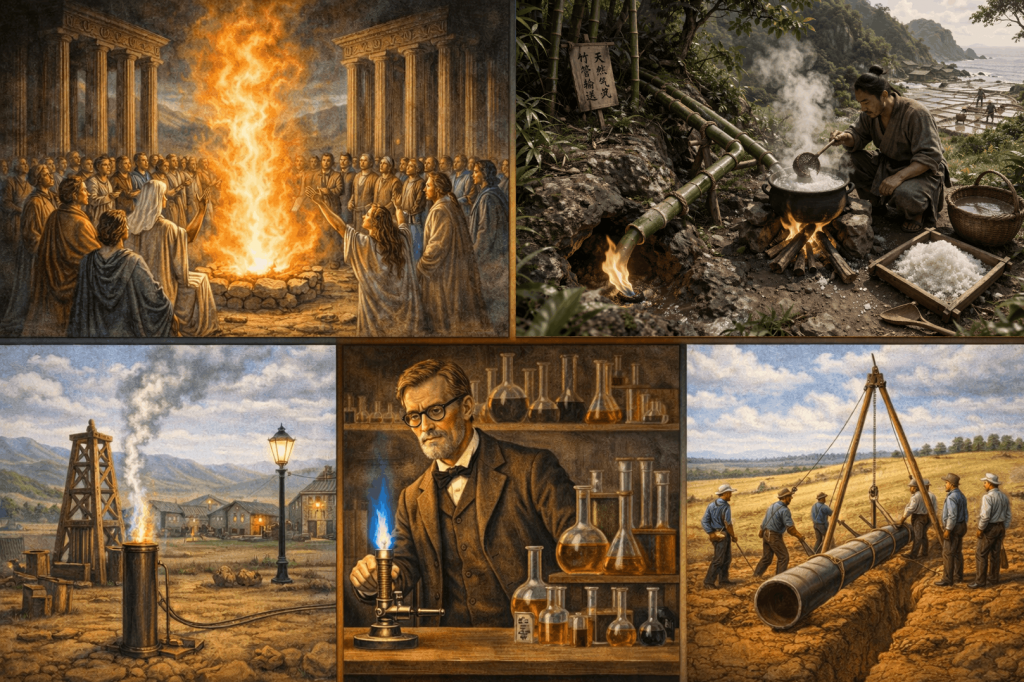
From Ancient Flames to the First Long Pipelines
The “eternal flame” at the Oracle of Delphi in Greece, around 1000 BC, is one of the earliest known examples of natural gas escaping from underground and being ignited, appearing to ancient observers as something spiritual or divine.
Five centuries later, around 500 BC, the Chinese not only made one of the first practical uses of natural gas, to boil seawater and produce salt, but also worked out how that gas could be captured and transported using bamboo stalks to make the first gas pipelines.
Yet it took two more millennia for the idea to catch on.
What about Coal?
For centuries, natural gas remained more curiosity than fuel. Meanwhile, another energy source, coal, was going to reshape the modern era.
Coal had been mined for 5000 years, notably in China. It was first used as ornaments, also known as “coal jade”, and later used for heating and light.
In Europe, the Romans used coal for heating public baths and metalworking during the 2nd and 3rd centuries A.D., but WOOD was the king, not yet coal, and it would take centuries for that to change.
But by 1550, as forests in Britain were cut down and used for its extensive navy shipbuilding and making iron, wood became scarcer and expensive. Coal was used by the blacksmith, making lime, and other “dirty” jobs. But the skyrocketing cost made people switch to coal for home heating and cooking.
And as demand surged, coal mining exploded in the 1600s. Perhaps this was the kickoff of what would be called “King Coal”, the fuel that powered industry, cities, and eventually entire economies all the way into modern times. And within a century Britain was mining more coal than the entire world combined.
Mines were getting so deep they were flooding with water. In 1712, Thomas Newcomen invented the first coal-powered steam engine specifically to pump water out of these British mines. This allowed miners to go deeper than ever before. In 1781, James Watt improved the steam engine design, making it much more efficient and powerful and adapted it to drive factory machinery. This is the “beginning” of the Industrial Revolution most people think of, when the steam engine moved from the mines into textile mills, iron foundries, and eventually trains.
Coal Gas Becomes Town Gas
In 1659, Thomas Shirley wrote a paper for the Royal Society about a “burning spring” in Lancashire Coalfield, near Manchester. He realized that the “air” (gas) coming from the coal bed underneath the water was what actually caught fire. In 1792, William Murdoch (an engineer in Cornwall) figured out how to “distill” coal in a closed iron pot to collect the gas and pipe it into his house and lit his house with it.
In 1807, London’s Pall Mall became the first street in the world to be lit by gas lamps. This was the “iPhone moment” for coal gas—everyone saw it and wanted it. Cities like Baltimore (1816), Paris (1820), and Berlin (1826) started building massive “Gasworks” plants to turn coal into gas for street lighting. Coal gas became known as “Town Gas” and use of this new fuel took off.
Coal or Coal Gas?
Burning coal for heating, and even cooking was still very cheap. And though it filled London with soot and gas was cleaner, gas was much more expensive and considered a luxury item. It would take further technological changes to impact what had become King Coal.
One notable development occurred in 1855, when German scientist Robert Bunsen developed a device that mixes gas and air to create a controlled flame (the Bunsen burner). This invention made it much easier to use gas safely and efficiently for heating and laboratory work, foreshadowing the extensive use of gas for cooking and industry.
Natural Gas gets Drilled and Piped
In 1821, in Fredonia, New York, William Hart drilled what is widely considered the first natural gas well in the United States. Gas from the well was transported through hollowed-out wooden logs to nearby buildings. Though wood pipes were rapidly changing to iron in the 1840s, leaks were a big problem.
But while Coal Gas dominated the 1800s, natural gas was mostly a curiosity. Commercial use had started small in Fredonia, but it wasn’t until the 1859 Pennsylvania oil boom, when natural gas, often found with oil (now called “associated gas), started to gain more attention. By the 1880s, Pittsburgh’s steel mills and homes used it for steady heat, with the New York Times even hoping it would finally clear the city’s coal smoke.
The First Long Pipelines
The major limitation of natural gas was distance.
You had to live right near the production source to use natural gas because we lacked long-haul pipelines. These would require new technology, such as better sealing methods and early compression technology. And some of this was solved in 1891, with the first major long-distance natural gas pipelines being completed. It transported gas from Indiana to Chicago, covering roughly 120 miles. This was a major milestone. For the first time gas was being moved not just across a town, but across a region.
The Pattern Emerges and a New Beginning
Even at this early stage, one pattern emerged, an economic truth we know well:
- Pipelines were built where enough demand existed, following economic opportunity
- New technology allowed further expansion
At first, these systems were local. Then they became regional. But both the demand and technology drove something entirely new to the world:
A fully interconnected national system.
In Part 2, we’ll look at how these early systems evolved into a national network, and why understanding that system will bring you more success as a natural gas analyst, or anyone trying to do better in today’s gas market.