
CERAWeek 2026 wrapped up against a backdrop of tightening supply and demand balances and rising geopolitical risk: conditions that are rapidly reshaping how natural gas, LNG, and infrastructure are being evaluated across global markets.
This year’s theme, “Convergence and Competition: Energy, Technology and Geopolitics,” proved less aspirational than pragmatic and predictive, as discussions repeatedly circled back to the accelerating power demand from AI and data centers and the growing fragility of global energy supply chains amid ongoing conflict in the Middle East. The result was a conference less focused on aspiration and more on concepts analysts focus on daily: constraints, finding value, justifying projects that may be supplying energy to regions anywhere in the world.
Key Takeaways
Chris Wright (U.S. Secretary of Energy)
He stated how vital natural gas was to the United States energy mix noting that it is the largest source of home heating and is responsible for 43% of power generation within the country. He also noted that continued growth is to be expected with further investments into AI and LNG.
Chad Zamarin (President and CEO of Williams)
He brought attention to the present need for more transportation capacity, “Ten years ago, we were building three times the amount of electric transmission lines that we will build this year. Ten years ago, we were building three times the amount of pipeline capacity that we will this year, at a time when we need more than we’ve ever needed.”
We are also covering the need for more pipeline infrastructure as part of a series of articles covering the evolution of the U.S. natural gas pipeline system.
Zoë Yujnovich (CEO of National Grid)
She echoed this sentiment, “In Storm Fern, we had about 90% of the electricity in New York being provided by gas. But as most people are aware, we have some upstream gas pipeline constraints, which makes it very difficult to get the gas flowing into the right location. So the cost of not having that capacity in the system does translate directly to affordability.”
Energy leaders around the world are in agreement, more energy is needed and we must take the steps at all levels to ensure that we can meet the needs of the future.
James Brooks, COO of RBAC, was on the ground at CERAWeek and shared firsthand insights valuable to natural gas analysts and industry stakeholders.
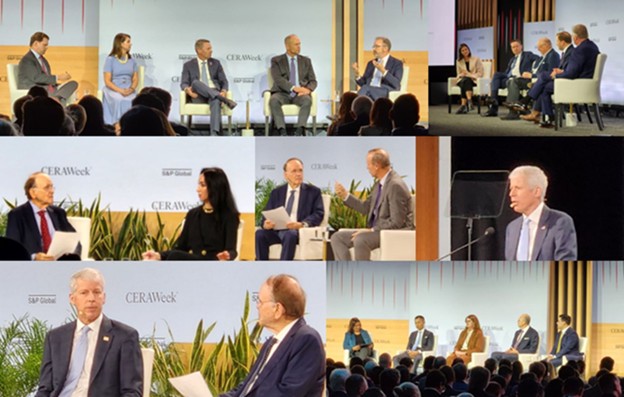
CERAWeek provided a great platform for a lot of dynamic and consequential discussions, shaped heavily by the ongoing global LNG supply shock triggered by Iran’s attacks on Qatar’s Ras Laffan facility and the closure of the Strait of Hormuz. These events and the resulting declaration of force majeure affecting roughly 20% of the world’s LNG supply were the backdrop for nearly every conversation throughout the week.
There was also a lot of discussion around the need for a lot more investment in gas and LNG infrastructure. This was quite a shift from previous conferences I have attended that focused on moving away from natural gas in favor of renewables. However, to facilitate this, there would need to also be a shift in energy regulatory direction.
The conversation between S&P’s Daniel Yergin and FERC’s Laura V. Swett highlighted the growing consensus that FERC must return to its core mandate and streamline approvals. The U.S. will need substantial gas infrastructure expansion to meet growing domestic and global energy demand.
In further conversations, including the discussion “Balancing Act: Price, Reliability, and the Global Call on US Energy”, it is clear that no one is talking about an LNG supply glut in the early 2030s at this point. The global market outlook changed dramatically following the Iranian conflict, opening meaningful growth opportunities for U.S. LNG developers and exporters.
A headline moment came from TotalEnergies, which announced it would exit two offshore wind leases and redirect nearly $1 billion into U.S. oil, natural gas, and LNG projects. This move was widely seen as a major win for North American energy security and a signal of shifting global investment priorities.
Some of the most inspiring conversations centered on lifting billions out of energy poverty. As OMV CEO Alfred Stern put it, “Energy is a foundation of a good life.” Secretary of Energy Chris Wright echoed the theme, “Expanding energy expands opportunity.”
An underlying message came out of CERAWeek. There is a profound shift in global energy markets back towards a more pragmatic and sustainable approach. The disruptions in the Middle East, combined with shifting investment priorities and growing demand for secure, affordable, and reliable energy, are reshaping both policy and commercial strategies. This does not mean that concerns over the environment have been forgotten. Only that a new workable approach is needed.
For RBAC, these developments reaffirm the critical importance of robust modeling tools and scenario analysis. As uncertainty grows, our ability to provide rigorous market insights will be essential for companies navigating the next decade of global gas and LNG dynamics.
It is with market simulation tools such as GPCM® Market Simulator for North American Gas and LNG™ and G2M2® Market Simulator for Global Gas and LNG™ that businesses and governments alike can gain insight into the market at large and understand how each piece of the puzzle fits in and affects the big picture to forecast future market conditions under any scenario.
Would you like a demonstration of RBAC’s market simulation tools? Click here for a demo or to contact us for more information.
RBAC, Inc. has been the leading provider of market fundamental analysis tools used by the energy industry and related government agencies for over two decades. The GPCM® Market Simulator for North American Gas and LNG™ is the most widely used natural gas market modeling system in North America. RBAC’s G2M2® Market Simulator for Global Gas and LNG™ has been instrumental in understanding evolving global gas and LNG dynamics and is vital in fully understanding the interrelationship between the North American and global gas markets.