
By Cyrus Brooks, RBAC, Inc.
In Part 1, we traced how the U.S. natural gas system evolved from the first long-distance pipelines into a regulated interstate network, then through shortages, deregulation, and the restructuring that turned pipelines into open-access transporters.
In Part 2, the story shifts from the pipelines in the ground to the market forces moving through it: trading, open access, price signals, and the way supply, transportation, storage, and time finally began clearing together across one connected system.
Section 6 – The Trading Layer (1978–1997)
Let’s step back a little bit and look how the gas market existed from the “trading” point of view, from earlier days to today.
By the late 1970s, the gas market was beginning to change, but “trading” still looked nothing like the modern desks we think of today.
After the Natural Gas Policy Act of 1978 started loosening wellhead price controls, companies began doing more contract repositioning than true market trading. In plain terms, pipelines, producers, and utilities were renegotiating long-term deals, swapping supply obligations, and trying to solve who was long gas (had more contracted supply than needed) versus who was short deliverability (had demand but not enough pipeline or supply access to physically serve it).
Even after that, pipelines still controlled both the molecules and the transportation paths, so most deals remained relationship-based, local, and focused on balancing physical obligations rather than managing market risk.
The first real market shift came after FERC Order 436 in 1985, when pipelines began offering open-access transportation (letting others pay to use the pipe instead of only moving their own gas). This was the moment gas itself became separable from transportation. Open Access To Natural Gas Transportation presentation, reserve transport separately, and resell it into a citygate or utility market somewhere else.
That was the beginning of true path economics—the idea that the value of gas now depended not just on the commodity price itself, but on the cost, availability, and flexibility of the route and pipelines used to move it.
In 1989, Congress finalized the end of the remaining wellhead price controls, giving producers and buyers confidence that the commodity itself would soon be fully market-priced. That certainty encouraged more forward contracting (agreements made today for gas to be delivered and priced in a future month), allowing producers to lock in revenue and utilities to lock in future costs rather than simply absorb price swings.
Prices Move Through Time
On April 3, 1990, natural gas futures began trading on NYMEX, centered on Henry Hub. These were standardized contracts that let buyers and sellers lock in a gas price for a future month. In simple terms, this gave producers, utilities, marketers, and traders a way to hedge (reduce price risk by locking in future prices). A producer could protect future revenue, a utility could protect winter procurement costs, and traders could temporarily hold that price risk in between.
This changed the market in a profound way: gas was no longer priced only by where it was flowing, but also by when it would be needed. Instead of panic buying ahead of winter or panic selling in oversupplied periods, the market could begin adjusting prices more gradually over time.
- futures (future month prices)
- calendar spreads (price differences between months)
- seasonal spreads (winter vs. summer value)
- basis (price differences between locations)
The physical and commercial players in the market also had to manage decisions across very different time horizons—from daily balancing (keeping supply and demand matched in real time so pipeline pressure remains stable) and short-term weather risk to seasonal storage decisions, multi-year transportation commitments, and even long-term infrastructure planning. Trading became the grease that made handling gas across all of these time horizons possible, using different types of contracts and trades to move risk and value to the participants best able to manage them.
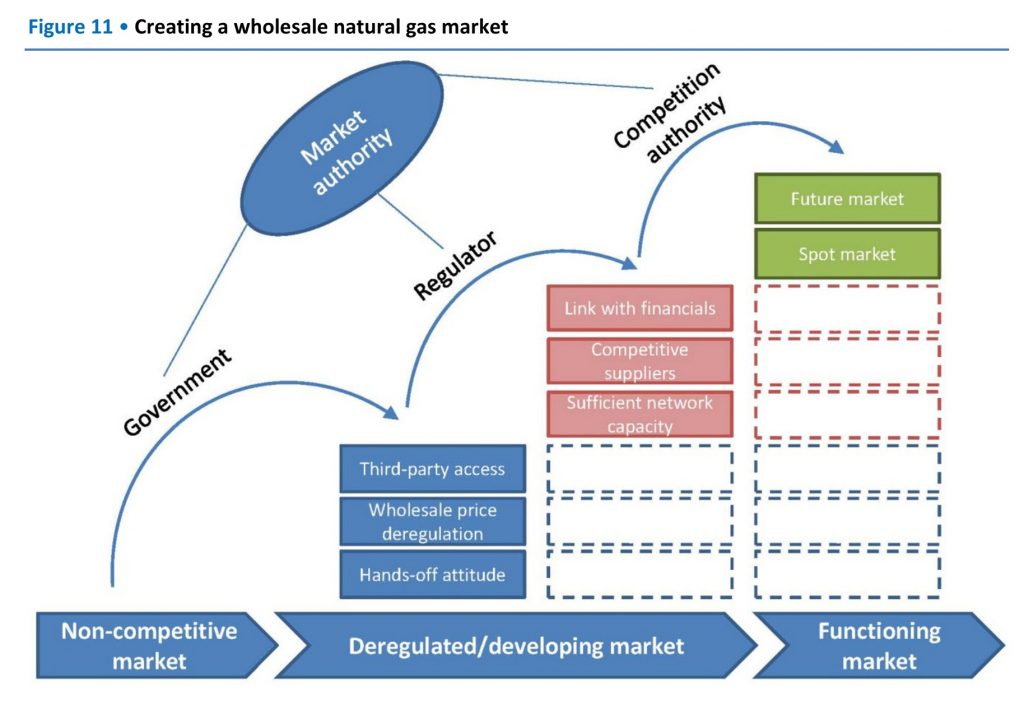
Importantly, 1990 made these trades possible, but 1992 made them practical at scale.
Roads and Cars (Pipelines and Gas) Separate
That’s because in 1992, FERC Order 636 completed the physical restructuring, making open-access transportation mandatory (was voluntary after Order 436) and fully unbundling transportation from commodity sales.
Pipelines had become neutral transporters—the road itself—while producers, marketers, utilities, storage operators, and traders became the customers using that road to move gas where it created the most value.
Before these reforms, pipeline companies often owned the gas, transported it, and delivered it—so they also carried much of the commercial and operational risk (what can go wrong, and who bears the cost when it does) associated with supply, price swings, and deliverability.
In that sense, the reforms were not necessarily negative for pipelines: while they gave up commercial control, the changes also spread risk more widely across producers, utilities, marketers, and traders—placing more of each risk type with the participants best equipped to manage it.
This is when basis trading truly began to scale, because location differences could now be seen clearly as separate economic signals rather than being hidden inside bundled gas-and-transport contracts. In other words, the market could finally distinguish between gas scarcity and transport scarcity.
By 1993, wellhead deregulation was fully in effect, meaning both the commodity price and the transportation system were now being shaped by market signals rather than federal controls.
Then another important layer was added.
In 1996, FERC allowed negotiated transportation rates, meaning pipelines and shippers could agree on custom transportation pricing terms as long as a standard regulated rate remained available. This made transportation itself more commercial and flexible, adding another dimension to trading decisions: not just gas price, route, and timing, but now also custom transport terms.
Layers Start Talking
By this point, the system had become physical, financial, locational, seasonal, and contractual all at once.
The market was no longer simply moving gas, but allowing gas to actually move where it was needed, moving value across time, geography, storage, contracts, and pipeline constraints simultaneously. Gas could move more smoothly from lower-value periods and regions into higher-value ones before physical stress became a crisis.
And by 1997, it was becoming increasingly clear that no one could mentally track how all of these layers—supply, transportation, storage, basis, and time—would rebalance across the full North American network from one desk.
To understand what the market had now become, we first need to step back and look at what it really means for a natural gas market to “clear.”
Section 7 – The Market Finally Clears
By 1993, North American natural gas had become the first truly market-based system capable of clearing across all of its major layers simultaneously.
Before 1978, pipelines owned both the “road” and the gas moving on it. Interstate prices were regulated and often set below the market‑clearing level (the price needed to attract enough supply). As a result, although contracted gas still flowed interstate, new drilling shifted toward intrastate markets where prices were freer to rise, and interstate shortages followed.
The Natural Gas Policy Act of 1978 began repairing that first layer of supply by gradually loosening wellhead price controls. More supply could now economically move into interstate systems.
Order 436 in 1985 changed the next layer: transportation. Pipelines increasingly became transportation providers rather than the sole merchants of supply. Gas ownership and pipe ownership began separating though pipeline companies continued to sell gas bundled with transportation.
The Wellhead Decontrol Act of 1989 added certainty by setting the final end date for remaining price controls.
Then in 1990, Henry Hub futures introduced a new layer or dimension: time. The market could now clear not just by how much and by what route gas moved, but by when participants needed it.
Finally, Order 636 in 1992, finished what Order 436 had started by fully unbundling gas sales from transportation and enabling capacity release (the resale of unused pipeline space). With pipelines acting strictly as open-access carriers rather than merchants, prices and transportation rights could now respond more directly to market conditions. And followed by the end of wellhead prices at the start of 1993, all major layers were aligned and able to be cleared for the first time:
- production
- transportation
- basis
- storage
- futures
- seasonal spreads
- route competition
One could argue that this is the real birth of the modern competitive natural gas market.
What Market Clearing Actually Means
“In a competitive industry, the price of a good is determined by the level of supply and demand. … If there is a price at which the amount of gas supplied is equal to the amount of gas demanded, that price and quantity define the market-clearing price and quantity.” – The Theory and Practice of Modeling with GPCM, by Dr. Robert Brooks
In simple terms, market clearing means supply and demand meet at a price where the gas actually moves and gets sold. That means:
- the gas finds a buyer
- the buyer is willing to pay enough
- transport is available
- storage economics still work
- no major surplus is stranded
- no major shortage remains
A simple analogy is a vendor brings 300 hot dogs to sell at a high school football game. If 500 people come to the game and 300 want hot dogs at the posted price:
The market clears.
If the vendor brings 500 hot dogs, but not every one wants one at that price, or maybe they’d prefer hamburgers or even pretzels:
Those extra hot dogs do not clear.
They stay unsold.
The same applies to unused pipeline capacity, uneconomic storage, or surplus supply. The unused part does not clear.
Market Clearing of Natural Gas
Suppose a new industrial complex opens along the Gulf Coast, alongside a growing metro area that adds 10,000 residents. Together, they are expected to require an additional 100 MMcf/d of natural gas for power, heating, and industrial use.
If pipelines can deliver that gas, buyers are willing to pay the prevailing price, and the gas displaces or complements existing supply without forcing prices sharply lower, then:
The market clears the additional 100 MMcf/d.
That means the gas:
- flows through the pipeline system,
- reaches end users who are willing to pay for it,
- earns enough margin to justify production and transport,
- and does not leave excess supply stranded elsewhere.
So clearing simply means: the extra volume successfully finds a profitable home in the market.
How Each Layer of the Market Clears
Let’s look at market clearing across several layers at once.
1) Production clears
At the wellhead, the market clears when the gas price is high enough to bring forth just enough drilling to meet demand.
If the price is too low: drilling slows
If the price rises: more supply enters
This is the first layer.
2) Transportation clears
The next layer is pipeline capacity. This is not the gas, but the right to move it. And this itself can be traded (if not needed for example).
So, Firm transport (guaranteed capacity rights) clears when the pipeline route is fully used, but not overbooked.
Congestion raises the value of transport. Unused routes reduce it.
3) Citygate markets clear
The citygate is where natural gas enters a city’s local distribution system. Each local market, from Chicago to New York to Atlanta, must clear independently. The citygate price reflects:
- upstream gas cost
- transport constraints
- local weather demand
- competing inflows from multiple pipelines
Each city is effectively its own supply-and-demand balancing market.
4) Basis clears
A price difference between two locations is called basis. Basis clears when the price spread equals: transportation cost + congestion + regional risk
So if Henry Hub is $3 and Chicago citygate is $3.40, then the $0.40 basis is the location-clearing signal and this is the market’s way of pricing geography.
5) Futures clear
Futures introduced market clearing by time. Now the market also balances what future gas is worth today. This allowed all stakeholders, from producers to LDCs, from pipelines to traders, to all take steps to establish future price, as well as future risk. This meant winter risk, seasonal uncertainty, and future demand shifts cleared ahead of time.
6) Storage clears
Storage is where time and geography meet. Storage clears when:
Winter price – summer price = storage cost + risk
If the spread is wide enough: storage fills
If not: it stays empty
This is how seasonal scarcity gets economically balanced.
What Happens When Markets Fail to Clear?
When the natural gas market fails to clear, the “gears” of the system grind to a halt because physical constraints prevent prices from balancing supply and demand, resulting in localized price spikes, or dislocations, where the cost of gas at a citygate far exceeds the source price due to pipeline capacity constraints.
This failure often manifests during high demand situations, such as in winter storms, and where bottlenecks are seen in pipelines which cannot meet peak demand, or with operational failures such as compressor station outages, or production freeze-offs during extreme cold. You can even have stranded supply such as, where high oil prices attracted more oil production, but associated gas lacked transportation, leading to negative prices, forcing producers to pay others to take the gas or flare it into the atmosphere.
Ultimately, a market that fails to clear acts as a bright beacon distress signal, indicating the possibility of a critical mismatch that usually requires long-term investment in new pipeline infrastructure, expanded storage facilities, better resilience, or enhanced peak-shaving capabilities to restore reliability. Each of which would help move the market back toward more efficient clearing.
The Efficient Natural Gas Market
The above are the core economic layers through which the natural gas market clears; and though many things influence gas prices, they all ultimately work through these same basic layers of supply, transport, location, and time.
By 1997, this had become a highly efficient market. But…
it had become much harder to see everything.
Before 1978, players had their assigned roles and government control made action fairly rigid. But by 1997, the amount of players involved in the market had exploded. Market decisions by the thousands, happening daily and in competition with one another. Before, a market participant may ask simply:
Can I get the gas?
But now the question becomes:
At what price and quantity will every layer of the market clear once all players make their moves?
That is a much harder question.
A pipeline expansion could change basis.
Changes in basis could alter storage injection and withdrawal decisions.
Storage behavior could reshape seasonal and forward price spreads.
Forward price signals could influence future drilling decisions.
Over time, shifts in supply could reshape downstream flows and congestion.
Every layer now talked to every other layer.
That is what made the post-1993 market so powerful, but also so analytically difficult.
By 1997, the market had finally learned how to clear across supply, transportation, location, storage, and time—but understanding how all of those layers would interact before they actually happened had become the next great challenge.
Look out for Part 3, where we’ll explore that story—how shale, LNG exports, and entirely new forms of demand reshaped the map again, and how the analytics side of the house finally caught up.
Would you like a demonstration of RBAC’s market simulation tools? Click here for a demo or to contact us for more information.
RBAC, Inc. has been the leading provider of market fundamental analysis tools used by the energy industry and related government agencies for over two decades. The GPCM® Market Simulator for North American Gas and LNG™ is the most widely used natural gas market modeling system in North America. RBAC’s G2M2® Market Simulator for Global Gas and LNG™ has been instrumental in understanding evolving global gas and LNG dynamics and is vital in fully understanding the interrelationship between the North American and global gas markets.