
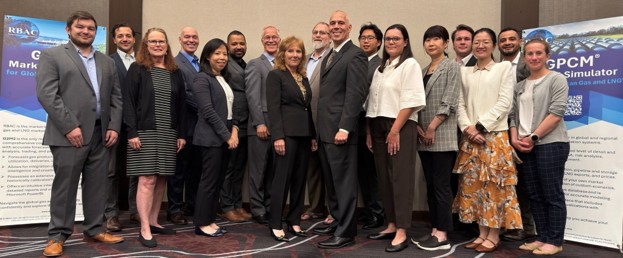
The RBAC 2026 Gas & User Conference, held September 9th to 11th welcomed users, partners, and energy industry experts to Denver, Colorado, where over three days, we explored shifting natural gas and LNG markets, infrastructure development, rapidly growing power demand, new tools and approaches to market analysis, and especially, ever more practical ways to get more out of GPCM® and G2M2® market simulators.
Naturally, this year’s conference focused heavily on market uncertainty and what we can do about it as analysts.
LNG expansion, geopolitical disruptions, data center and AI-driven power demand, new pipeline infrastructure, and the growing connection between North American and global gas markets all created a common question: not simply what will happen, but how will the market respond under different assumptions?
“The real challenge is really how different assumptions and market events may impact the future outcome. That's where market simulation becomes very valuable.”
James Brooks, COO, RBAC.
RBAC presenters were joined by guest speakers George Wayne Jr. of Kinder Morgan, Geoff Sloan of Poten & Partners, Anuj Patel of Siemens, Hua Fang of Black & Veatch, Charles Merrick of CRAI, Sergio Castellanos of the University of Texas RESET Lab, Manuel Garcia of Los Alamos National Laboratory, and Prakash Thimmapuram of Argonne National Laboratory.
“I think we're living in unpredictable times, and it's important to understand what are the implications of that.”
Sergio Castellanos, UT RESET Lab
North American and Global Gas Outlooks
RBAC’s latest GPCM North American and G2M2 global gas outlooks took the discussion across the North American market, including supply, demand, LNG exports, storage, infrastructure, Henry Hub prices and regional basis.
Data center demand continued to emerge as one of the major uncertainties facing the power and natural gas markets, while new pipeline development (such as the newly FID Solitude) is changing the outlook for major producing regions such as the Permian.
On the global side, the G2M2 outlook examined a market moving through near-term disruption and recovery, a substantial wave of new LNG capacity, and longer-term changes in global supply and demand in both Europe and Asia.
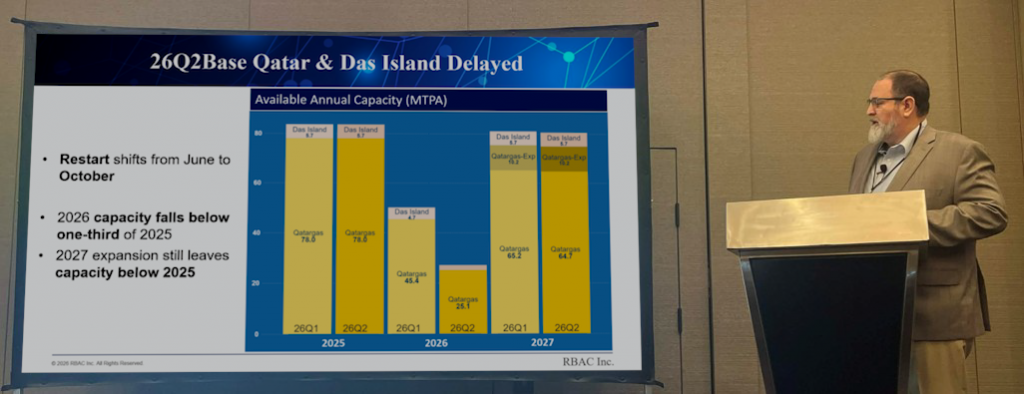
“When you're looking at these demand outlooks, you're seeing growth, but what's happening underneath that growth, you're getting a lot of reshuffling.”
Edward O’Toole, RBAC
Participants also saw a particularly interesting presentation on how GPCM and G2M2 can be used together in a case study demonstrating how changes in global LNG markets can work their way back into North American gas markets. Here analysts learned how they can iterate between the two models to get a more realistic view than working the domestic and global markets independently.
Infrastructure, LNG and a More Connected Market
Infrastructure remained a major theme throughout the conference.
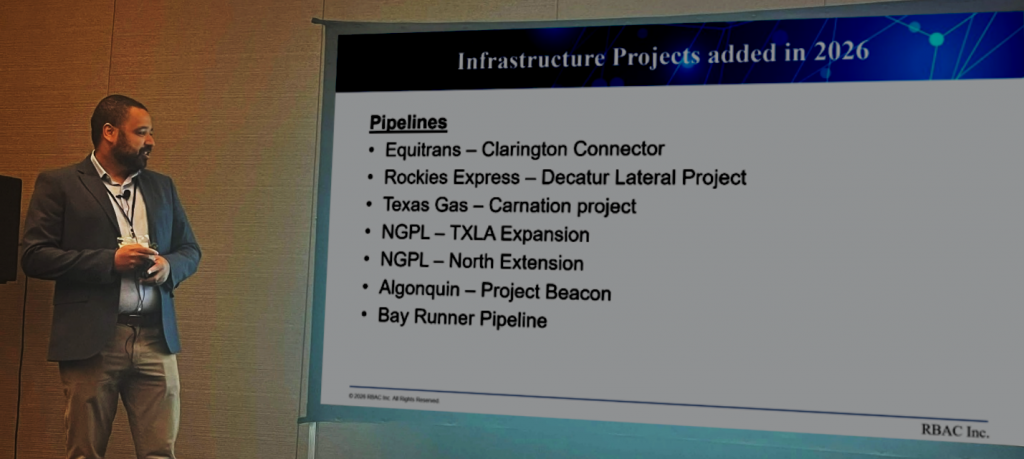
One RBAC case study used the Solitude Pipeline to demonstrate how a proposed infrastructure project can be modeled to examine broader effects on pipeline utilization, regional markets, and competing transportation routes.
“As more and more egress capacity comes online and strengthens the pricing fundamentals in the region, it's possible that gas stops being an afterthought and takes center stage.”
Robert Kachmar, RBAC
Guest speakers added perspectives from across the industry. Hua Fang of Black & Veatch and Charles Merrick of CRAI tacked generation, transmission, and gas infrastructure needed to support growing power demand, while Geoff Sloan of Poten & Partners addressed Henry Hub’s increasingly important position in global energy markets.
“The liquidity of Henry Hub is a big benefit. There’s great price discovery, a lot of trading, and quite a lot of access to molecules.”
Geoff Sloan, Poten & Partners
The conference also featured a fireside chat with George Wayne Jr. of Kinder Morgan focused on LNG, power demand, and North American infrastructure planning. Of many insights from Mr. Wayne, one thing stood out which was particularly applicable to data centers:
“Don't worry about the supply. How's supply going to get to you—the deliverability, how do you need it, pressure, time, location—that's what you should be focused on.”
George Wayne, Jr., Kinder Morgan
Data Centers, AI and the Future of Gas Demand
Few topics generated as much discussion as data center growth.
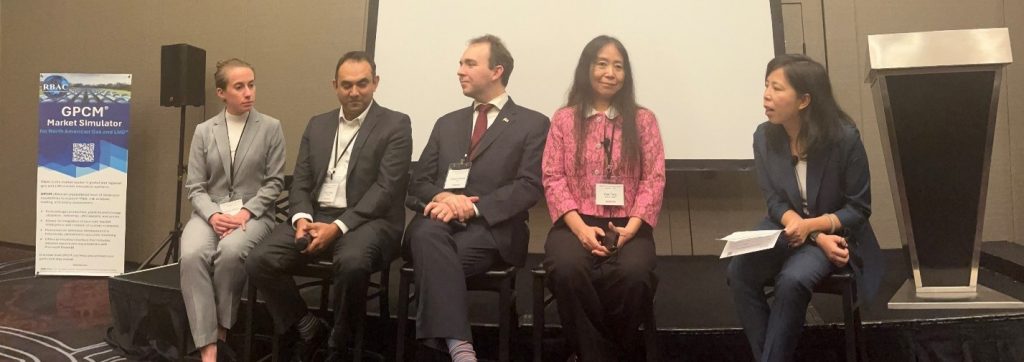
The conference brought together several perspectives on the issue, including presentations from Black & Veatch, CRAI and Siemens, followed by a panel moderated by RBAC’s Dr. Ning Lin. The discussions examined the relationship between rapidly growing electricity requirements and the generation, transmission, fuel supply, and infrastructure needed and whether they would be able to get it.
"Is there enough natural gas in the United States? We know that, but is there actually enough natural gas pipeline in the United States to support data centers?"
Charles Merrick, CRAI
As Anuj Patel of Siemens emphasized, announced data center capacity is not the same thing as actualized demand. Speed is everything and project timing depends on access to power supply, interconnection, equipment, permitting, fuel access, and other execution constraints. The challenges are immense and even growing (e.g. public push back) but so is the pace of data center buildouts.
"The data centers, they move at the speed of business; the utilities move at the speed of utility. And so there is a disconnect here. The tech companies are trying to win a war... on AI. So they need to go very, very fast. Utilities can't keep up. And so all this stuff that we talked about is how can we utilize the captive capacity in the system in the meantime while we build up.”
Anuj Patel, Siemens
Modeling the Expected (and the Unexpected)
Several sessions focused on improving the way analysts build and test scenarios — the key to getting the most out of GPCM.
“If you have a shock happening in the value chain... as analysts, what we're doing is [looking at] that shock to understand what are the levers we can actually pull in the model.”
Dr. Ning Lin, RBAC.
RBAC demonstrated GPCM “continuation cases,” which allow analysts to introduce an unexpected market event at a specific point in a forecast rather than allowing the model to anticipate it from the beginning. That provides a different way to examine events such as major storms [like Winter Storm Fern or Uri, or hurricanes], supply disruptions [think Hormuz], and other sudden changes in market conditions.
The conference also introduced attendees to G2M2py, a developing workflow for automating scenario creation, model runs, results extraction, and visualization using Python. The goal is to reduce repetitive manual work and give analysts more time to focus on the analysis itself and is applicable to both G2M2 and GPCM.
RBAC’s product-development presentation showed how these developments fit into a broader modernization effort, including expanded Python tools, scripting and APIs (such as G2M2py), improved visual analytics, and continued development toward easier and more flexible ways of working with GPCM and G2M2.
“Our long-term goal here is to make GPCM and G2M2 much more powerful than they ever have been before and much more available to you, so that we empower you as the analyst to do much more with the products, get more done, and ultimately make better decisions.”
Aaron Brooks, RBAC.
From Market Discussion to Hands-On Modeling
The final day shifted heavily toward practical user training.
Workshops covered GPCM storage, Power BI-based data visualization, supply curve development and elasticities, pipeline and infrastructure modeling, and building demand scenarios. Attendees were able to work through the methods behind the models and then apply them to practical examples.
The conference concluded with one-on-one sessions where attendees could bring their own model questions, scenario ideas, and workflow challenges directly to members of the RBAC team.
More Than the Presentations
As in previous years, some of the most valuable parts of the conference happened between the formal sessions. Roundtables, the conference reception, meals, breaks, and individual conversations gave users the opportunity to compare market views, discuss modeling approaches, and work directly with both RBAC experts and other professionals facing similar questions.
“This is a very good... environment for us to really communicate with each other about what we have seen in our own practice, our daily business, what's happening in the natural gas market and what implications [it] has.”
Hua Fang, Black and Veatch
Hear From Attendees
Good discussion of global markets and geopolitical impacts
P.H
Good to see how RBAC iterates between G2M2 and GPCM
C.M
Appreciated the thorough overview of the numerous implications of power demand growth.
C.H
Great insights and good information on integrated approach
S.B
Conclusion
The 2026 conference reflected just how interconnected natural gas markets have become. North American infrastructure decisions can influence LNG exports; global LNG events can work their way back into domestic markets; and new sources of electricity demand can create consequences for gas supply and transportation far beyond the individual project.
For analysts, planners, traders, consultants, and investors, that makes the ability to test assumptions and compare alternative market outcomes increasingly valuable.
Most importantly, the conference once again brought together RBAC users, industry experts, and the RBAC team to exchange ideas, improve modeling skills, and look at what may be coming next.
We look forward to seeing everyone again at the next RBAC User Conference!
Interested in learning more about one of the topics discussed at the conference or seeing what GPCM and G2M2 can do for your organization? Contact RBAC to schedule a demonstration.