
Projects most likely to change gas flows, prices, LNG supply and energy security
Assessing Pipeline Projects Around the Globe
We previously covered some of the largest LNG export projects in the United States as well as export growth in other countries. But today’s pipeline projects deserve the same spotlight because they determine whether gas can actually reach the market, connecting real supply to real demand, relieving a bottleneck, or opening a new route.
In North America and several other export-oriented regions, LNG projects have become the strongest demand anchors for new pipeline construction. But LNG is not the only driver. A pipeline’s market importance increasingly depends on what sits at the downstream end, whether that is a liquefaction plant, power plant or industrial load, or whether it is for import-substitution or regional security-of-supply.
Project Breakdown
In this two-part series, we break down such projects into three different Categories:
- Commercially grounded: Relieves a constraint or connects proven supply to visible LNG, power or industrial demand. Projects in this category such as Canada’s Coastal GasLink and Texas’ Blackcomb have identifiable supply, identifiable demand and a practical reason to operate.
- Diversification and resilience: Adds route diversity, interconnection, reversal capability or new regional access. Projects in this category such as southeastern Europe’s TAP expansion and the Vertical Gas Corridor strengthen route diversity, connect Black Sea or Caspian supply to new markets, and reduce dependence on a single corridor.
- Geopolitical optionality: Large strategic potential. But pricing, financing, gas allocation and/or timing remains unresolved. These are projects far larger in scale than categories 1 and 2 such as Asia’s Power of Siberia 2 and TAPI.
How to Read the Numbers
U.S. pipeline capacity is generally reported in billion cubic feet per day (Bcf/d), which is equivalent to 10.3 billion cubic meters per year (bcm/year), which is how European and Asian projects are usually reported, while Argentina and Brazil often use million cubic meters per day (MMm³/d). In this paper we use the units in the form most commonly employed in each market.
North America: LNG Demand Is Fueling the Pipeline Buildout
North America’s pipeline story has evolved from connecting regions to moving more gas out of producing basins and removing constraints. Now it is increasingly about linking production to LNG exports, coastal industry and power demand. RBAC’s 26Q2 GPCM Base Case sees U.S. LNG exports more than doubling from 14.9 Bcf/d in 2025 to 32.4 Bcf/d by 2035. Permian takeaway is especially important as associated gas production tests available capacity.
North American Pipelines at a Glance
United States:
- 44.9 Bcf/d planned during 2026–27
- 31.6 Bcf/d under construction
- 29.7 Bcf/d originating in Texas
- 8.4 Bcf/d originating in Louisiana
Canada:
- 2.1 Bcf/d
EIA estimates that the United States could add 44.9 Bcf/d of pipeline capacity during 2026–27, with 31.6 Bcf/d already under construction. About 29.7 Bcf/d is fueled by production in Texas and another 8.4 Bcf/d in Louisiana.
For example, the recently completed Matterhorn Express, a 580-mile pipe, has added 2.5 Bcf/d of new takeaway capacity from the Permian Basin, moving this gas to the Katy Hub area near Houston, Texas. And this is just one of many projects that are starting to reduce the pressure on Permian takeaway requirements. Matterhorn showed how additional Permian takeaway can relieve Waha congestion, where constrained takeaway has repeatedly contributed to negative prices. When oil prices are high and Permian oil production ramps up, having additional takeaway capacity for associated gas helps prevent local prices from collapsing.
Permian Takeaway Supply
Blackcomb is a 366-mile pipe under construction, expected in service in Q3 or Q4 2026, and will provide an additional 2.5 Bcf/d from Waha to the Agua Dulce hub, an important demand source for South Texas LNG terminals, exports to Mexico and other coastal market demand. It will give further relief to the Permian.
Hugh Brinson (Energy Transfer) is a 442-mile pipeline with a 1.5 Bcf/d Phase 1 ramp-up beginning in July 2026; Phase 2 compression will increase capacity to 2.2 Bcf/d. The pipe will connect West Texas production to existing pipeline infrastructure south of the Dallas-Fort Worth area, giving access to the broader Texas network, including local hubs and power demand. From there, customers will have the flexibility to reach multiple destinations in Texas and Louisiana, including export facilities along the Gulf Coast.
Moving Gas to Meet Gulf Coast Demand
Trident Intrastate (Kinder Morgan), a new 219-mile, 2 Bcf/d pipeline project with Phase 1 targeted for Q1 2027 and Phase 2 in Q4 2028, will deliver Katy-hub gas (supplied by incoming Permian pipelines like Matterhorn Express) the industrial corridor near Port Arthur, Texas. Its demand anchor is Golden Pass LNG, and the pipeline will also help meet gas-fired power plant demand in Southeast Texas.
Rio Bravo (4.5 Bcf/d) is the dedicated feedgas pipeline for Rio Grande LNG, linking the Agua Dulce Hub in South Texas to the Brownsville terminal, while Bay Runner (2.6 Bcf/d) adds a separate Agua Dulce-to-Port Isabel/Brownsville corridor for South Texas LNG demand. Together, they should deepen the demand pull at Agua Dulce, support regional gas prices, increase the value of upstream systems such as Blackcomb, and intensify competition for gas among LNG terminals, Mexican exports, power plants and industrial users.
Bay Runner is targeted for service in the second half of 2026, and Rio Grande LNG is expected to begin first LNG around 2027. Although some trackers list Rio Bravo completion in 2029, that likely reflects full build-out or final capacity rather than first gas, since initial feedgas must be available before Train 1 commissioning. Once fully operational, the facility’s first five trains will have approximately 30 MTPA of LNG production capacity, representing roughly one-fifth of current U.S. LNG export capacity.
Haynesville and Louisiana LNG
Pelican Pipeline provides the other side of the Gulf Coast supply story. While many Texas projects are designed to move Permian gas hundreds of miles toward LNG demand, Pelican will transport up to 2.5 Bcf/d of Haynesville gas from northern Louisiana 160 miles southward to the Gillis Hub. Its proximity to Louisiana’s LNG corridor makes Haynesville, where recent production has exceeded expectations, one of the most direct supply sources for the next wave of U.S. LNG export capacity.
The Port Arthur Pipeline Louisiana Connector (Sempra) pipeline is a dedicated LNG-feedgas pipeline rather than a general-purpose takeaway project, similar in market role to the Trident Intrastate Pipeline. The 2.0 Bcf/d system was built to supply the under-construction Port Arthur LNG Phase 1 facility and was entered service in June 2026, ahead of the terminal’s commercial startup currently anticipated in December 2027.
Canadian Opening the Pacific
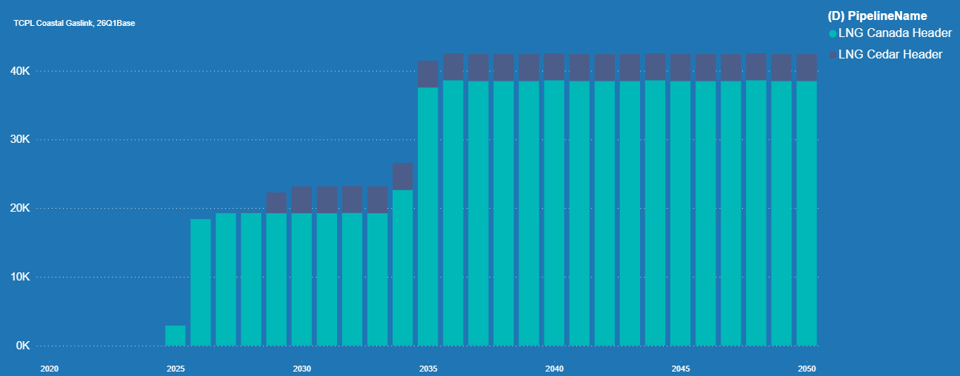
Coastal GasLink is Canada’s first large direct bridge for northeast British Columbia gas to Pacific LNG export projects. The initial system will carry about 2.1 Bcf/d to LNG Canada and could potentially expand to about 4.5 Bcf/d through additional compression.
The next step depends on LNG Canada Phase 2 and Cedar LNG. Coastal GasLink and LNG Canada reached new commercial agreements in March 2026 to advance the Phase 2 pipeline work, but the expansion remains subject to LNG Canada’s final investment decision. Cedar Link adds a smaller but important 0.4 Bcf/d connection to Cedar LNG in Kitimat, British Columbia.
Coastal GasLink, though still a major export corridor, will not reach its full 5 Bcf/d expansion potential without LNG Canada Phase 2.
Europe: Value from Interconnection, Debottlenecking, and Reverse Flows
Europe’s pipeline story looks very different from North America’s. Instead of a wave of giant greenfield projects (particularly those takeaway lines built around LNG feedgas demand), the most important European projects are mostly about getting more value out of the existing network: adding compression, debottlenecking likely interconnectors, reversing legacy flow directions while also linking the Black Sea and Caspian gas and imported LNG supply to Central European demand.
An example already in operation is the Baltic Pipe which began partial operation on 1 October 2022 and reached full 10 bcm/year operation on 30 November 2022, delivering Norwegian shelf gas through Denmark to Poland and the wider Central European market. It is one of the clearest recent examples of route diversification because it permanently replaced part of the region’s historical eastbound dependency with stable northwestern pipeline supply.
European Pipelines at a Glance:
Key Changes:
- TAP: 10 →2 bcm/year (expandable to 20 bcm/year)
- IGB: 3 → 5 bcm/year (under expansion)
- Black Sea gas via Neptun Deep (~2027)
- Trans-Balkan: reverse flows toward 5–7 bcm/year
Southern Gas Corridor: Trans Adriatic Pipeline Expansion
The Trans Adriatic Pipeline, in commercial service since late 2020, remains one of Southern Europe’s primary non-Russian pipeline import routes. Moving Caspian gas from offshore Azerbaijan through Greece and Albania to Italy, it also supports Balkan energy security via interconnectors like IGB.
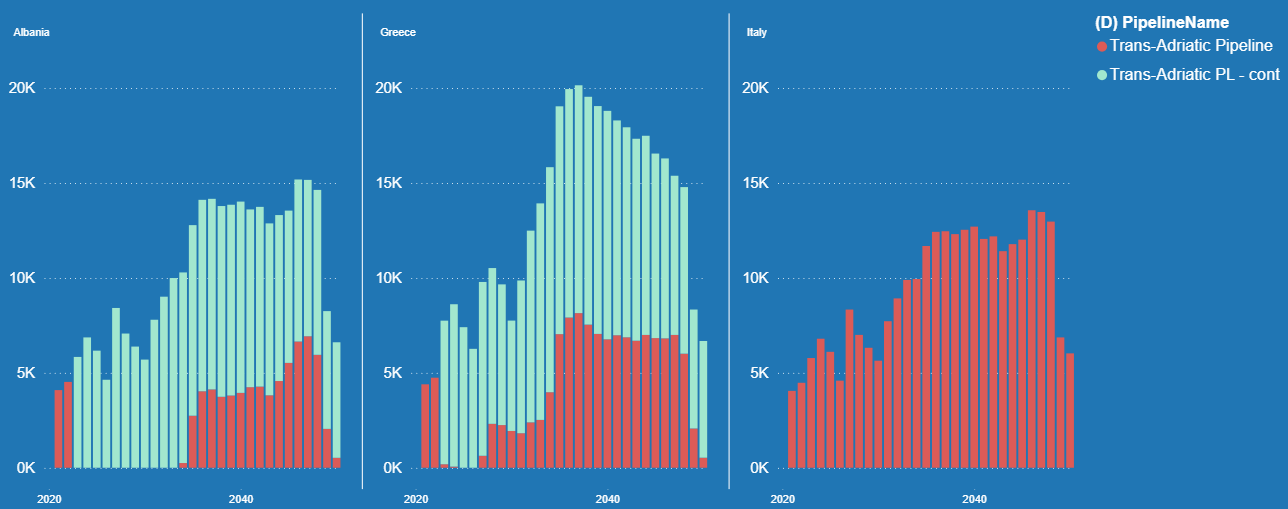
TAP’s baseline system handles 10 bcm/year, with a recent early-2026 expansion adding 1.2 bcm/year of long-term capacity via compressor upgrades at Kipoi. The pipeline is engineered to scale up to 20 bcm/year in phases; however, unlocking that next capacity tier remains contingent on binding market test commitments (open seasons), upstream Caspian field developments, and corresponding debottlenecking along the broader Southern Gas Corridor.
This phased structure illustrates Europe’s post-2022 midstream model: delivering steady, non-Russian baseload supply to Italy and the Balkans paired with LNG imports, all while buffering the region from excessive spot market volatility.
The Vertical Gas Corridor Network: IGB, Tuzla–Podisor and Trans-Balkan Reversals
The Vertical Gas Corridor is not a single pipeline but an evolving regional infrastructure project. It links import points in Greece northward through Bulgaria, Romania, Hungary, Slovakia, Moldova and Ukraine using a combination of existing pipelines, new interconnectors and targeted expansions. Its purpose is to move LNG landed in Greece, Caspian gas moving through the Trans Adriatic Pipeline (TAP), and future Black Sea gas deeper into Central Europe.
IGB (Interconnector Greece–Bulgaria) is the southern gateway of the corridor. It receives Azerbaijani gas from TAP in Greece while also providing Bulgaria and neighboring markets with access to Aegean LNG terminals. Since entering commercial service in October 2022, it has operated at about 3 bcm/year. Expansion work is underway to increase capacity to 5 bcm/year, with upgrades to the Komotini and Stara Zagora metering stations and associated compression and flow-control infrastructure. Once completed, this additional capacity will allow larger volumes of both Caspian gas and LNG to flow deeper into Southeast Europe, strengthening regional supply diversity and gas balancing.
Romania’s Tuzla–Podisor pipeline forms the next major link in the corridor. Completed and commissioned in 2025, it connects Romania’s future Neptun Deep offshore production in the Black Sea with the national transmission system, allowing those volumes to move farther into the regional network. Although the pipeline itself is operational, its principal gas source is still under development, with large-scale commercial production from Neptun Deep expected around 2027. Once offshore production begins, the line will provide more than 8 bcm/year of new Black Sea supply into Romania and strengthen indigenous gas flows throughout Southeast Europe.
The Trans-Balkan Pipeline forms the corridor’s northbound transport spine. Originally designed to carry Russian gas south toward Turkey, it now increasingly operates in reverse, allowing LNG entering Greece through IGB, Caspian gas arriving via TAP and, eventually, Black Sea gas entering through Tuzla–Podișor to move north into Romania, Moldova, Ukraine and Central Europe. The physical reverse-flow capability is already operational, but the corridor continues to evolve. Regional transmission operators are coordinating technical upgrades, compressor optimization and harmonized capacity products to increase firm northbound capacity, with current work aimed at supporting approximately 5–7 bcm/year initially and creating a pathway toward 10 bcm/year or more as market demand develops.
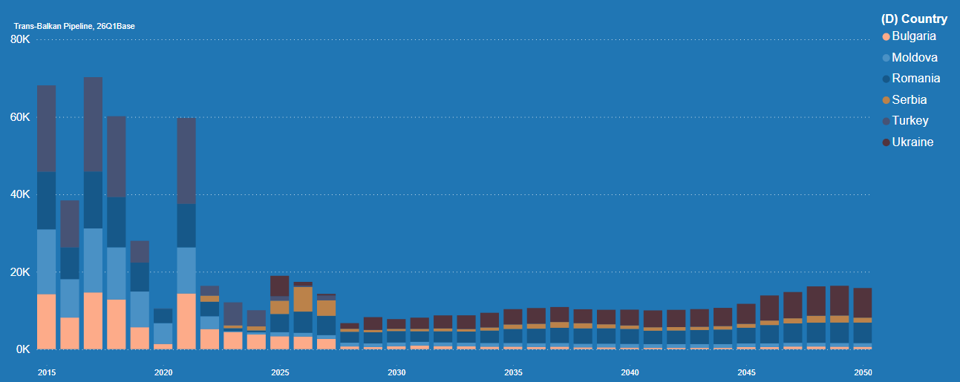
This Trans-Balkan Study concludes that the remaining challenges are increasingly commercial rather than physical, with tariff structures, cross-border capacity products and regulatory coordination now becoming the principal constraints on further utilization. A more integrated corridor could also improve access to Ukraine’s extensive underground gas storage, allowing LNG imported through Greece during lower-demand periods to be stored and later supplied into Central Europe during winter.
Future Import Connections from the Eastern Mediterranean and Africa
Additional European pipeline supply will also depend on infrastructure outside the continent and more will be said in other sections on Africa and the Middle East. But current developments are focused more on increasing deliveries through existing capacity than constructing new Mediterranean crossings. For example, Algeria and Spain are discussing raising Medgaz supplies this year by as much as 10% with a recent high-level meeting of the Spanish PM and Algerian President July 20th, 2026.
Large potential supply corridors, including the Trans-Saharan Gas Pipeline and the Nigeria–Morocco African Atlantic Gas Pipeline, could eventually deliver additional African gas toward Europe. Because their construction, financing and gas-supply challenges lie primarily within Africa, they are discussed in greater detail in the Africa section.
In Summary
The projects covered so far show that pipeline value is no longer measured simply by length or capacity. Increasingly, the most important projects are those that connect real supply with real demand, improve market flexibility, or create new trading options.
Part 2 will examine the next group of major pipeline developments across Africa, the Middle East, and Asia, from projects with clear commercial momentum to some of the world’s largest but most uncertain strategic corridors, and what they could mean for future natural gas markets.
RBAC’s market simulation tools can give insight into the natural gas market under a wide range of scenarios, including cases where geopolitics, infrastructure, demand growth, weather, or project timing move differently than expected. To discuss a scenario or schedule a free demonstration, contact RBAC.
RBAC, Inc. has been the leading provider of market fundamental analysis tools used by the energy industry and related government agencies for over two decades. The GPCM® Market Simulator for North American Gas and LNG™ is the most widely used natural gas market modeling system in North America. RBAC’s G2M2® Market Simulator for Global Gas and LNG™ helps users understand evolving global gas and LNG dynamics and the interrelationship between North American and global gas markets.