

Natural Gas: Records, Rerouting and Rising Demand
Natural gas continues to serve as a key element in the global energy system, and this has been reinforced by rising as due to rapid growth from data centers and AI, combined with new LNG export projects coming online. However, geopolitical shocks are once again reminding markets how fragile global gas flows can be as conflict in the Middle East has disrupted LNG flows.
In this edition of the RBAC Newsletter, we look beyond forecasts to examine some of the factors shaping future gas and LNG markets. New U.S. natural gas demand records being set, Norway’s changing role in Europe’s energy mix amidst a tight global LNG market, and a scenario study where Power of Siberia 2 comes online earlier, these stories provide additional context for understanding where the market may be headed next.

Want analysis that goes beyond headlines? Join RBAC’s mailing list to receive this newsletter, early access to new articles, and expert perspectives delivered straight to your inbox.
Top Stories in Natural Gas and LNG from Around the World
- New Pipelines Set To Ease Permian Natural Gas Glut
- QatarEnergy extends LNG force majeure and charters out tankers into October
- Alaska LNG Needs More Offtake Commitments Before Final Investment Decision
- U.S. Natural Gas Futures Steady Ahead of Storage Data
- Australian shale gas to fuel proposed $28 billion AI data center project
Quick Brief – U.S. Natural Gas Production Set New Record in 2025
Yet again the United States saw new natural gas records set, this time for overall production. It grew to an average of 118.5 bcf/d for 2025 which is a 5.3 bcf/d increase from the prior year.
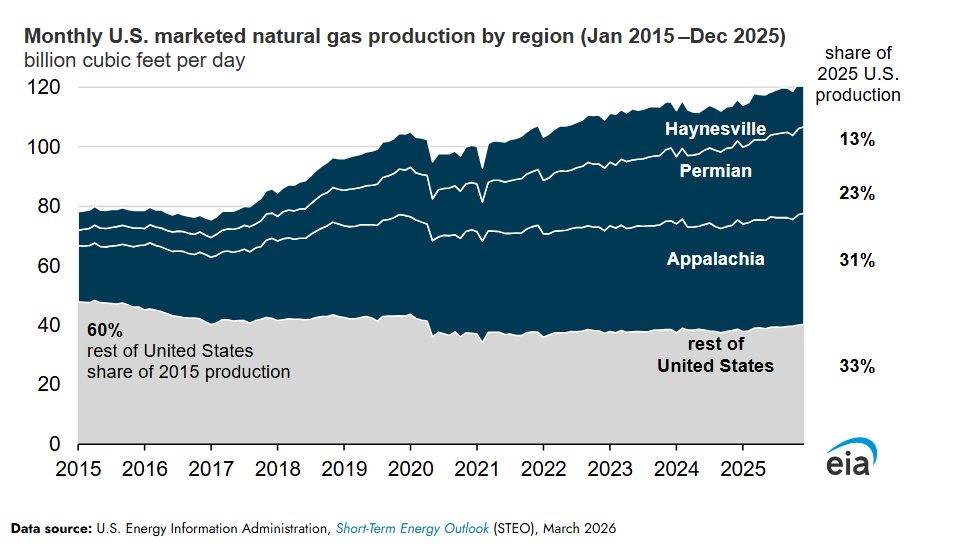
Permian saw the most growth by far and when combined with Appalachia and Haynesville they accounted for 67% of total production across the country.
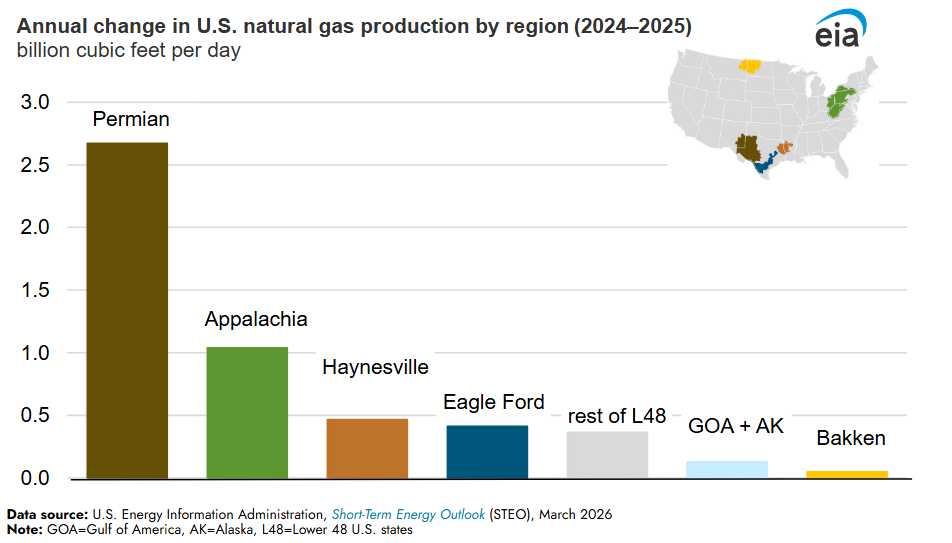
The Appalachia region had the most production of all regions at 36.6 bcf/d, however the growth rate of production has been slowing due to limited pipeline takeaway capacity to physically transport the gas.
For 2026, we can likely expect more production records to be broken with new demand from data centers resulting in higher usage of gas for power generation. Additionally, continuously growing LNG demand will also play a factor especially with the current conflict in the Middle East changing market dynamics.
It is with tools like the GPCM® Market Simulator for North American Gas and LNG™ that allow for natural gas analysts to fully understand the entirety of the North American natural gas market and how each piece of the puzzle fits into the big picture.
GPCM simulates historical and future natural gas industry activity. Historical simulations are used to help calibrate GPCM for use in forecasting future market conditions. Analysts use simulations for scenario analysis and forecasts for North American gas flows, price and basis.
It is a complete system of interrelated models for simulating gas production, pipeline and storage capacity utilization, deliveries to LDCs, utilities, and industrial consumers, as well as commodity price at points throughout the North American market. GPCM’s purpose is high-quality market analysis in support of investment decisions which help you achieve your goals and that of your company or organization.
Click here to learn more about GPCM and schedule a free demonstration today!
Articles & Media
What Would Happen if Power of Siberia 2 Came Online Earlier than Expected?
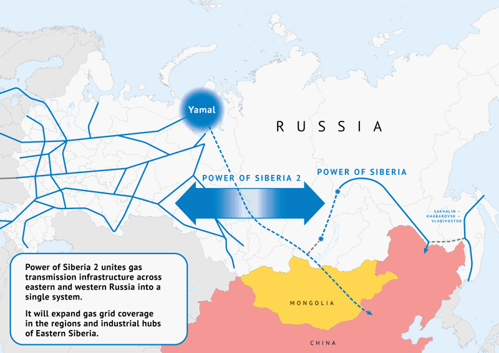
If Power of Siberia 2 enters service earlier than expected, the largest impact may not be the pipeline volume itself, but how that volume changes China’s next marginal gas purchase — plus, how many LNG cargoes will be produced or available to China and where will those LNG cargoes eventually go that China no longer needs?
Read What Would Happen if Power of Siberia 2 Came Online Earlier than Expected? to find out what would happen if POS2 entered service earlier than current expectations.
Europe’s Search for Gas Security: Norway’s Expanding Role in a Tightening Global LNG Market

With volatility caused by war, uncertainty, and perhaps even fear, what does RBAC see in its global gas and LNG outlook? In this article, our analysts break down both supply and demand outlooks by region, see where gas flows are shifting, and examine the impacts of conflict and uncertainty around the world.
Read Europe’s Search for Gas Security: Norway’s Expanding Role in a Tightening Global LNG Market to find out.
Essential Reading
Taken from the treasure trove of the writings from our energy experts. Here read technical insights and far-sighted analysis relevant through the lens of today’s energy.
New Power Plants Surging in the Permian Basin
In prior articles on Virginia and Texas, we modeled gas-fired generation at the state level, adjusting demand at a macro scale. Given the number and size of new projects emerging in West Texas, however, we took a more granular approach: modeling the impact of individual power plants directly within the GPCM® Market Simulator for North American Gas and LNG™.
By adding several large electric power customers in the Permian region, we were able to observe how incremental demand reshapes regional supply, flows, and pricing dynamics.
RBAC is the market-leading supplier of global and regional gas and LNG market simulation systems used by the energy industry and related government agencies for over two decades. The GPCM® Market Simulator for North American Gas and LNG™ is the most widely used natural gas market simulation system in North America. RBAC’s G2M2® Market Simulator for Global Gas and LNG™ has been instrumental in understanding evolving global gas and LNG market dynamics and is vital to fully grasp and leverage the interrelationship between the North American and global gas markets.