

Natural Gas Goes Negative
One of the most interesting Natural Gas market phenomena in the last few years is the behavior of Waha Hub natural gas prices, or lack thereof. What I mean is that gas producers have had to accept negative prices for their production, to keep more valuable oil flowing. This phenomenon was first seen in 2019 however, it has become increasingly frequent as basin production outpaced available takeaway capacity.
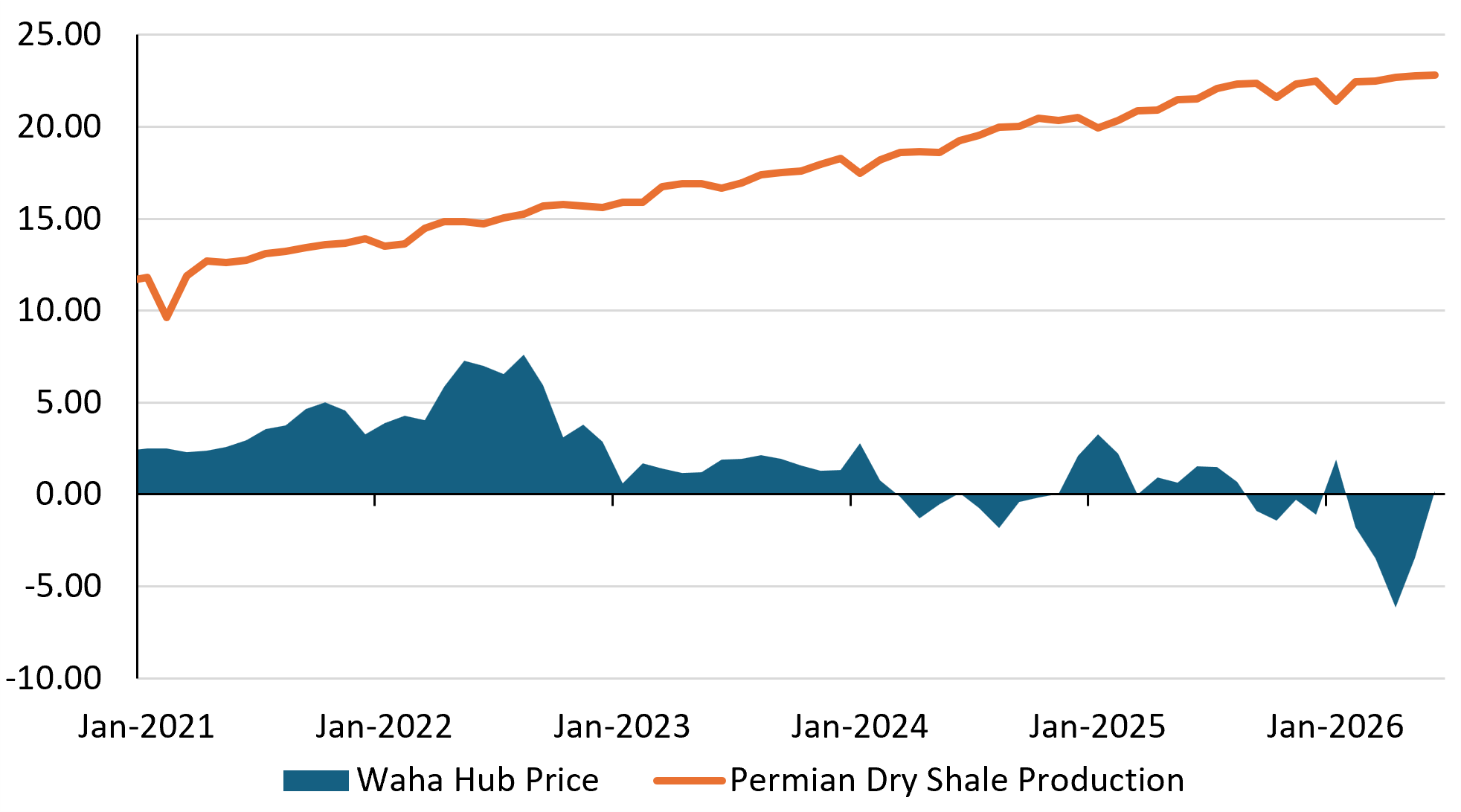
The economics behind negative gas prices are well understood. Production of natural gas in the Permian basin has increased dramatically since 2016, growing from a mere 2.1 Bcf/d in January of 2016 to nearly 23.0 Bcf/d in May of 2026. However, egress from the basin has struggled to keep pace with production, which is largely produced as a byproduct of growing and more valuable oil production in the region. In 2024, negative Waha gas prices were observed for 172 days (or nearly 50% of the time). That fell in 2025 to only 105 days, with price relief coming from the startup of the Matterhorn pipeline in late 2024. Relief, however, was short-lived, as gas prices have traded negative for much of 2026 (158 days as of June 1, 2026), oil production has risen and associated gas production has once again outpaced takeaway capacity.
However the outlook for, Waha prices finally look more bullish with the introduction of 4.5 Bcf/d of additional egress capacity to the region expected this year. The Gulf Coast Express (GCX) natural gas pipeline was the first of these developments, adding about 0.6 Bcf/d of takeaway capacity. The two other pipelines – the Hugh Brinson and the Blackcomb – will provide the lion’s share of 2026 takeaway capacity.
Given the interest and impact of Permian egress, Gas Pipeline Competition Model was used to examine the timing, ramp up rate (i.e., how quickly these pipelines would fill) and within Permian basin supply areas for this new capacity. GPCM is uniquely qualified to conduct such analysis as its database includes individual pipeline capacities for the entire North American pipeline network, as well as identifying supply and demand implications for other basins and regions.
Pipelines in the Permian
Hugh Brinson
Hugh Brinson pipeline is a two-part greenfield pipeline, expected to add 2.2 Bcf/d of takeaway capacity from the Permian basin. The 400-mile pipeline, owned by Energy Transfer, will transport natural gas from the Permian Basin to Maypearl Texas, about 40 miles south of Dallas and Ft. Worth. Phase 1 of the project includes the mainline and lateral construction to connect the pipeline to ET’s assets in the basin, while Phase 2 adds additional capacity via compression.
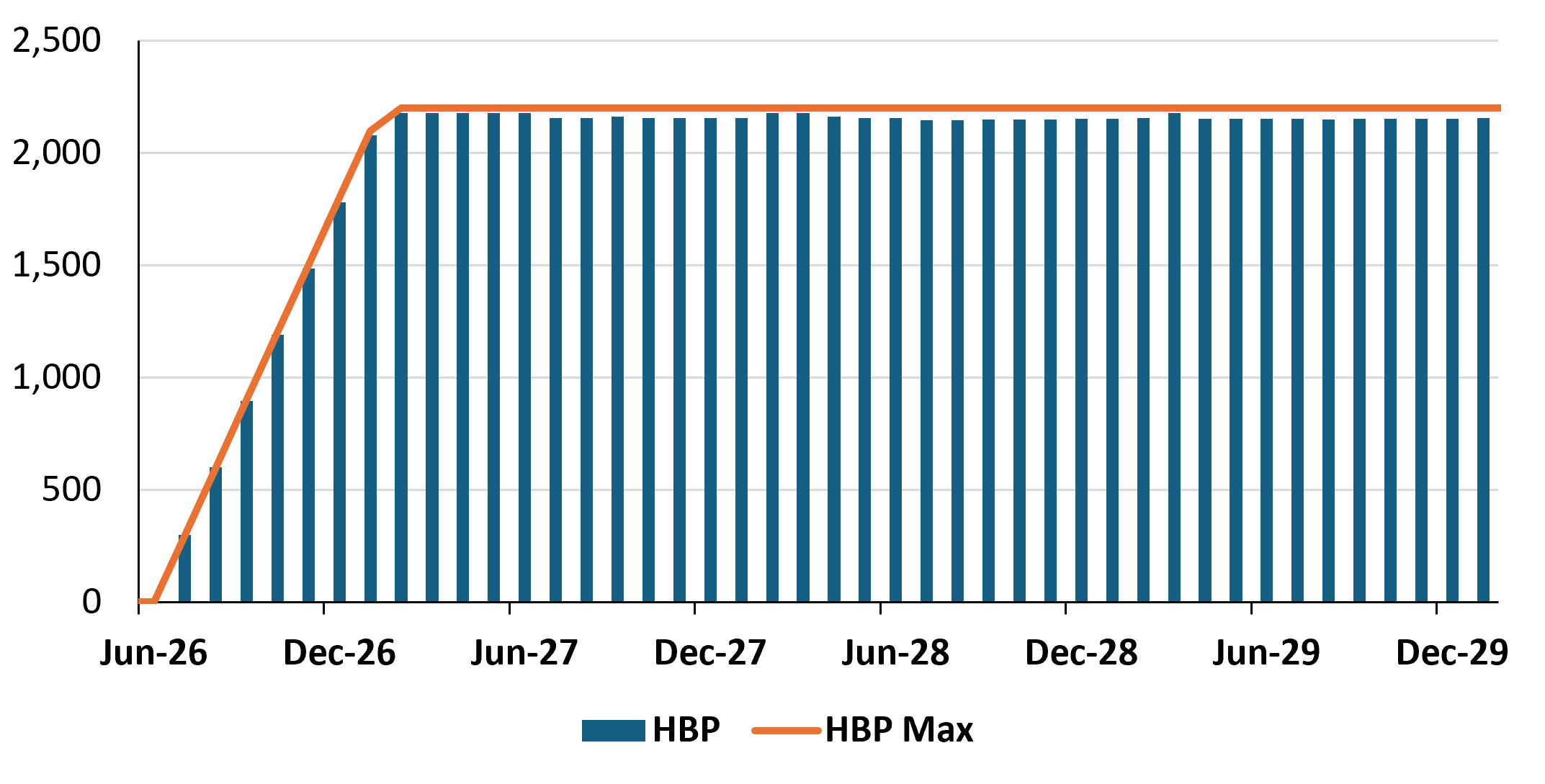
Sources indicate that Phase 1 is already flowing, and we expect a phased ramp-up of capacity finishing at the full Phase 2 capacity early in 2027. As shown in Figure 2, the Hugh Brinson reaches its maximum capacity almost as soon as it comes online (here, at 300 MMcf/d in July, with the capacity ramping up to 2.2 Bcf/d by February 2027). Flows increase as the pipeline’s capacity ramps up, with utilization staying at or near 100% for the next few years.
The gas flowing through the Hugh Brinson is primarily sourced through the Delaware portion of the Permian Basin, providing on average two-thirds of the pipeline’s receipts from suppliers, with flows from the Midland providing the other third.
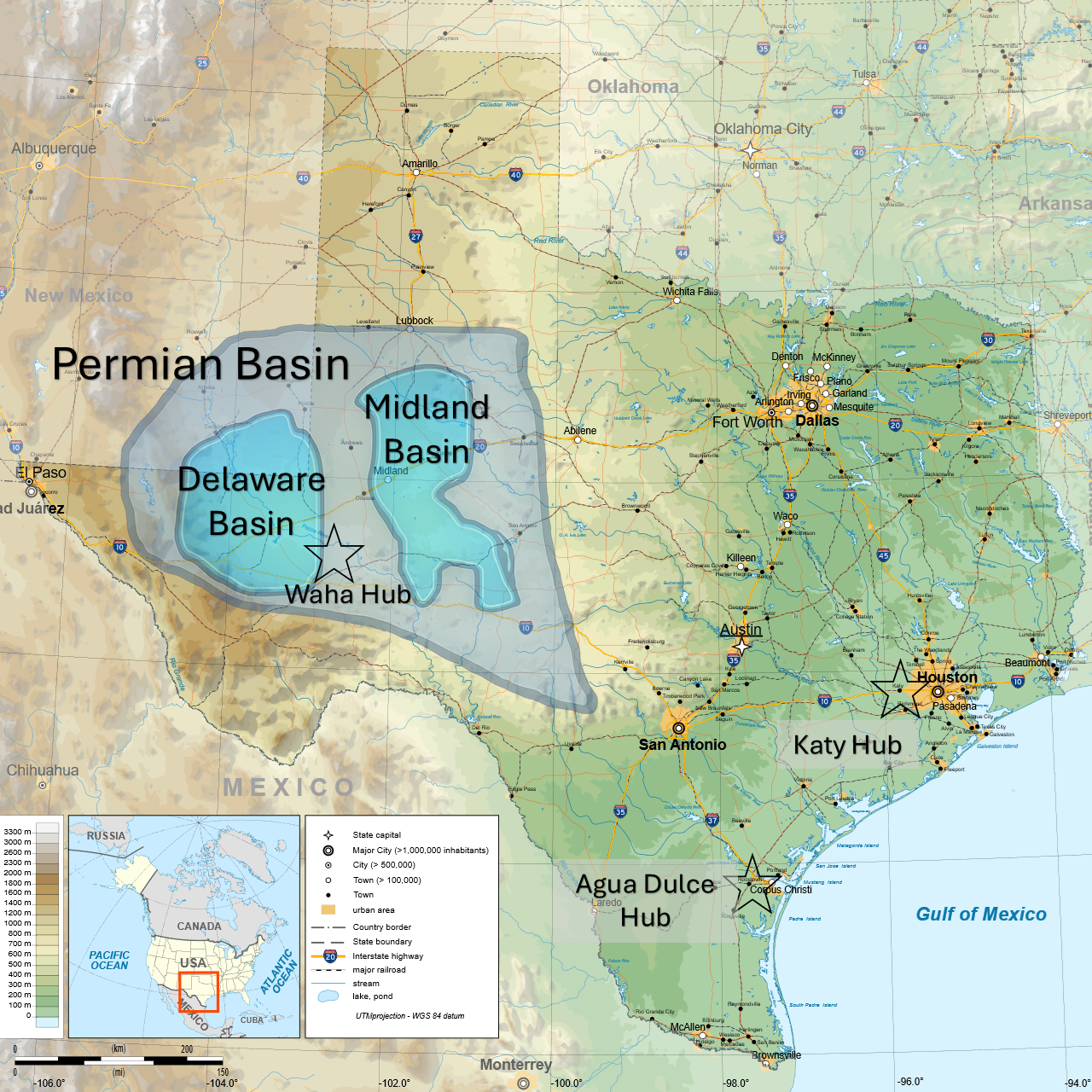
Beginning in 2030, Hugh Brinson’s receipts from these supply areas decrease slightly to make space for flows from an interconnect with Double E pipeline, which is scheduled to begin service in 2030. Hugh Brinson will then flow east, delivering natural gas to pipelines via several interconnects in the Agua Dulce Hub, a major South Texas hub about 35 miles west of Corpus Christi allowing Permian producers to sell gas to other pipelines or buyers for LNG exports and local demand.
Blackcomb
Enbridge’s Blackcomb pipeline is the other 2026 featured Permian pipeline and is expected to provide 2.5 Bcf/d of takeaway capacity from the basin to Agua Dulce Hub. The project reached FID in late 2024 and is expected to begin service in Q3 of 2026.
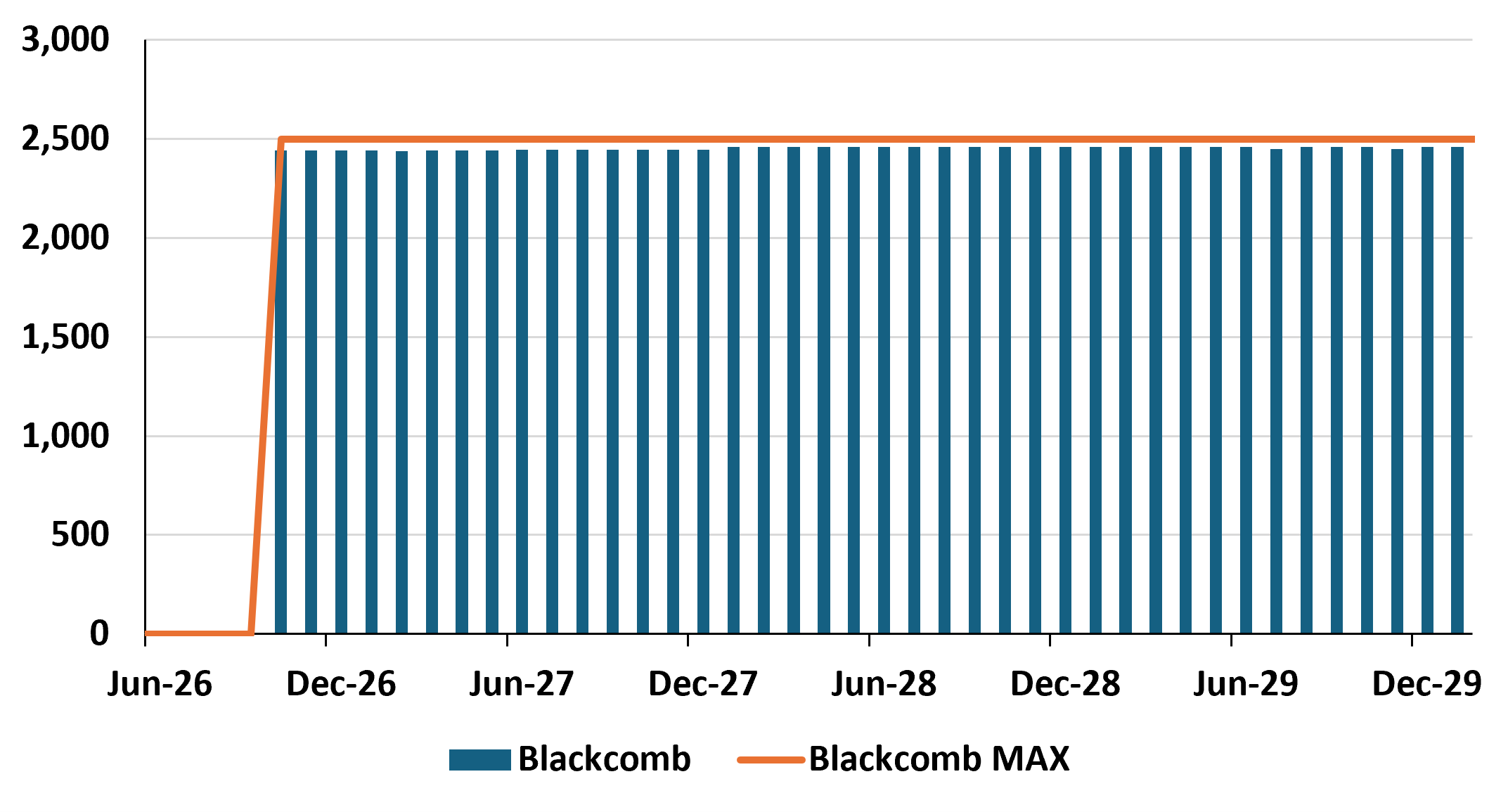
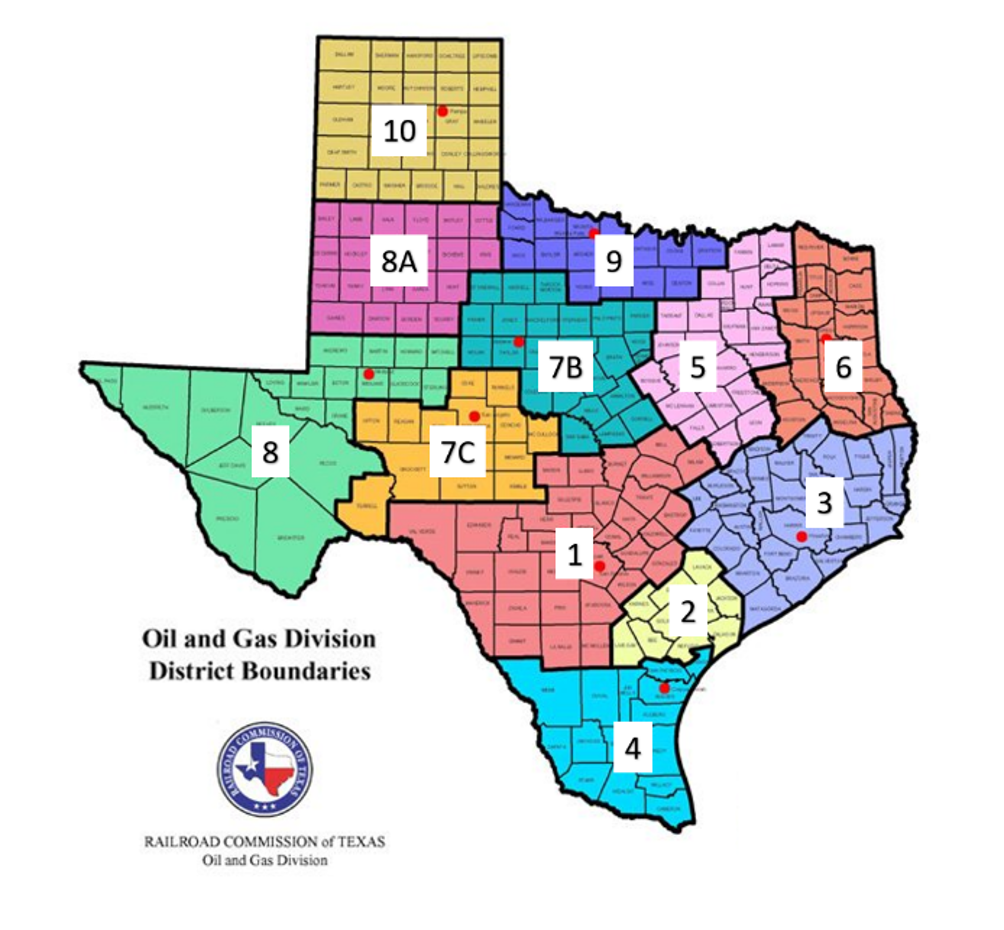
Like the Hugh Brinson, Blackcomb pipeline reaches 100% utilization when it starts up (here, Oct-2026) and remains that way for the next four years. The pipeline receives gas from the Midland portion of the Delaware basin, which covers both Texas RRC district 8 and 7c – though most of the flows come from the RRC 8 portion of the Basin. Deliveries originally flow to the aforementioned Agua Dulce Hub, but starting in 2027, a direct interconnect with the Traverse pipeline provides an additional outlet and a dedicated pathway from the Corpus Christi area to the Katy Hub, though it delivers gas a bit southeast of the area into the Matterhorn Express pipeline.
Aggregate/Long Term viewpoint:
Production versus Egress Build
Permian takeaway capacity additions are expected to continue after 2026, with projects such as Eiger Express (3.7 Bcf/d, expected to come online in 2028), and Transwestern’s Desert SW expansion (2.3 Bcf/d, expected 2029 in-service date). This is in addition to several other pipelines that, while not directly impacting Permian takeaway capacity, will increase transport options for shippers in and around Agua Dulce and Katy Hubs; examples include Blackfin, Traverse, and Trident pipeline projects, among several others.
The unanswered question is how well this new capacity will keep pace with Permian natural gas production, which is expected to reach 32.7 Bcf/d by 2035 in the 26Q2 Base case.
In the short term, Waha prices are forecast to rise from the monthly average of $0.21/MMBtu from June 2026 to slightly over $3.80/MMBtu by January 2027—GCX coming online keeps June prices from going negative, followed by prices rising coming into winter. The coming additional takeaway capacity will allow more supply to satisfy growing demand.
After this prices are expected to rise further into the mid-$4.00/MMBtu range through 2030, with some seasonal price variation, as more Permian egress capacity comes online, and demand continues to grow on the east Texas side. This strengthening of the Waha Hub will likely come at the expense of Henry Hub prices, meaning the impact to basis will ripple through North America.
Uncertainties
If another pipeline or LNG facility reaches FID or is delayed, prices will also adjust accordingly. For example, the Texas LNG Project is close to reaching FID, following the announcement of a $500-million-dollar investment from multiple investors to support the project’s development and early construction. Texas LNG, or another similar facility entering service, could substantially alter utilization rates or flows from the Permian through the above new egress options detailed above. Alternatively, global events could also change underlying fundamentals – if the Middle East conflict were to further push up oil prices, Permian oil output, and thereby associated gas production, may end up higher than expected, and even more egress capacity could be required.
This type of analysis – ramp rate, supply sourcing, impacts of further pipeline expansions on pre-existing in service pipeline utilization rates and how the entire network re-balances – is just one of the many uses ideally suited for the GPCM Market Simulator for North American Gas and LNG.
Generally, the North America natural gas network does not operate in basin, state or regional vacuums. Similarly, as more of the global gas supply/demand balances are impacted by North American LNG supply, the need for scenario analysis increases.
Not only is GPCM an unparalleled optimized simulation system, but special built-in features such as the Auto-Expand analysis also allow users to see where, when, and what pipelines meet user specified economic thresholds that permits a pipeline or pipeline zone to automatically expand after pre-determined dates. This is just one of many features that users can adjust or turn on/off to help identify opportunities and risks to ensure better decision-making.
As Permian production, takeaway capacity and downstream demand continue to evolve, GPCM provides the network-wide perspective needed to understand where gas will flow and what those changes will mean for the broader market.
RBAC, Inc. has been the leading provider of market fundamental analysis tools used by the energy industry and related government agencies for over two decades. The GPCM® Market Simulator for North American Gas and LNG™ is the most widely used natural gas market modeling system in North America. RBAC’s G2M2® Market Simulator for Global Gas and LNG™ has been instrumental in understanding evolving global gas and LNG dynamics and