

Projects most likely to change gas flows, prices, LNG supply and energy security
Part 2: Where Pipelines Meet Geopolitics
In Part 1, we looked at major pipeline developments in North America and Europe. North America is seeing large new pipelines built around takeaway capacity for growing production and feeding both LNG exports and power demand, while Europe is increasingly focused on expanding, reversing and improving infrastructure connections already in place.
Part 2 takes us into the Middle East, Asia-Pacific, South America and Africa, where projects vary greatly in size and scope, and could reshape regional or even global gas trade, but still depend on political agreements, pricing, security or financing. This is particularly true of megaprojects such as Power of Siberia 2, TAPI, Trans-Saharan and African Atlantic gas pipelines .
When we ask how likely, we can ask do the projects have clear supply, demand, financing and construction schedules? As discussed in Part 1, the question is what problem does the pipeline solve, what supply and demand sit at either end, and how likely is it to actually operate at or near significant capacity?
We begin in the Middle East, where some of the most important pipeline investments are motivated by rapidly changing domestic gas needs, rather than by LNG exports.
Middle East & Eastern Mediterranean
The Middle East and Eastern Mediterranean contain some interesting examples where domestic consumption, regional trade and LNG exports are drivers for new pipelines.
Saudi Arabia’s Master Gas System Phase Three (Expected 2028)
Saudi Aramco’s mega project is ~4,000 kilometers of pipeline and 17 new compression trains that will move an additional 3.15 Bcf/d across the Kingdom by 2028, bringing more Saudi-produced gas to power plants, industrial users and petrochemical facilities. Jafurah gas field is a major supply source and its development has been touted as the Middle East’s own Shale Revolution. Jafurah holds an estimated 200-plus Tcf of gas and is one of the largest unconventional gas developments outside North America.
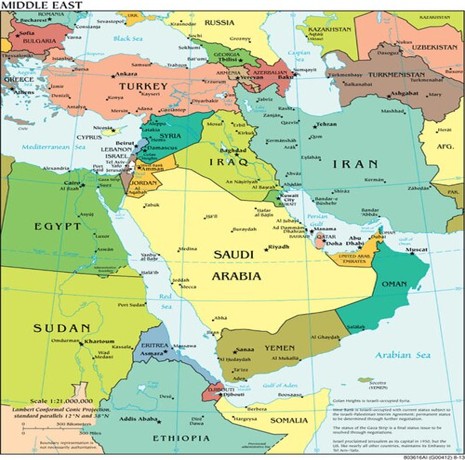
The project was already part of Aramco’s long-running gas expansion strategy rather than driven by the Iran conflict; however, recent regional instability and concerns around Gulf export chokepoints make its strategic rationale stronger: more domestic gas production, less oil burn in power generation, larger internal transportation networks and greater system resilience all become more valuable when maritime chokepoints such as the Strait of Hormuz are under threat.
Israel–Egypt Expansion Systems (2026 – 2029)
Chevron and its partners gave the go-ahead for a $2.36 billion Phase 1B expansion in January 2026 to raise Leviathan’s production from 12 to 21 bcm/year by 2029. But near-term flows are also already increasing: Leviathan added a third gathering line, while Israel Natural Gas Lines completed the 46-km Ashdod–Ashkelon subsea loop along Israel’s southern Mediterranean coast in July 2026. The loop connects into the East Mediterranean Gas (EMG) pipeline, which crosses from Ashkelon to El-Arish in Egypt’s Sinai Peninsula, and lifts EMG capacity from 6.5 to 8.5 bcm/year.
The Nitzana pipeline, scheduled for late 2028, will provide another route into Egypt. The 65-km overland line will cross Israel’s Negev Desert from the Ramat Hovav area to the Nitzana border crossing, adding roughly 600 MMcf/d of capacity and supporting Leviathan’s $35 billion, 130 bcm supply contract with Egypt’s Blue Ocean Energy.
In the short term, higher Israeli pipeline imports can help Egypt offset its domestic production decline and reduce LNG imports. Longer term, if Egypt’s domestic balance improves, additional Israeli gas could find its way to the Idku and Damietta LNG export facilities and strengthening Egypt’s role as a regional gas and LNG hub.
Cyprus–Egypt Offshore Gas Connections (2028–2031)
Cyprus and Egypt are proposing two subsea pipeline projects that would connect offshore Cypriot gas directly with Egypt’s existing processing and LNG infrastructure.
Cronos (Expected 2028) is now the more commercially advanced project. Eni and TotalEnergies took FID on July 28, 2026 for the Block 6 development south of Cyprus. Four deepwater wells will send gas by subsea pipeline to Egypt’s existing Zohr offshore infrastructure, which will carry it to shore and ultimately to the Damietta LNG plant on Egypt’s Mediterranean coast. Production is targeted for 2028 at 500 MMcf/d, equivalent to about 2.8 Mtpa of LNG, with Eni and TotalEnergies each marketing half of the volumes.
Aphrodite (Planned; Expected 2030–2031) would create a second Cyprus–Egypt route. Chevron, Shell and NewMed plan to send gas from the field southeast of Cyprus through a new subsea pipeline to Port Said, Egypt. The partners and Egypt’s EGAS are working to finalize commercial agreements in 2026, while front-end engineering design (FEED, the detailed engineering work before an investment decision) continues. The project currently targets FID in the first half of 2027 and production around 2030–2031.
Together, the projects could help Cyprus monetize offshore discoveries without building its own LNG export terminal, while providing Egypt additional gas for domestic use or LNG exports when its supply-demand balance permits.
Asia-Pacific: The Biggest What Ifs
The Largest Potential—the Most Challenging
Asia-Pacific contains the projects with the largest potential to change global LNG competition, but also the widest gaps between political announcements and financial execution.
Russia–China Pipeline Routes: Power of Siberia 1 & 2 and the Far Eastern Route
Russia supplied approximately 38.8 bcm through Power of Siberia 1 in 2025, slightly exceeding its original 38 bcm/year contractual level. The parties have also agreed to increase Power of Siberia 1 deliveries to 44 bcm/year, reinforcing the route as a core part of China’s overland gas supply.
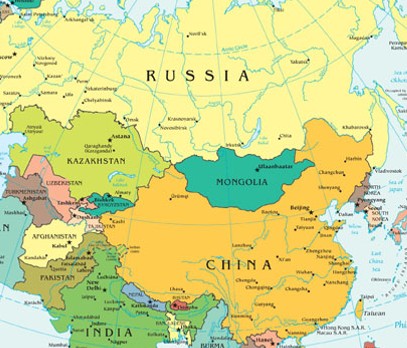
The Russia–China Far Eastern Route is scheduled to begin deliveries in January 2027 and has been increased from 10 to 12 bcm/year. It is tied into the Sakhalin–Khabarovsk–Vladivostok system and serves Northeast China, entering its domestic network at Hulin, about 300 km northeast of Vladivostok, its main impact is likely to be regional supply diversity and marginal LNG-import displacement in northern coastal markets.
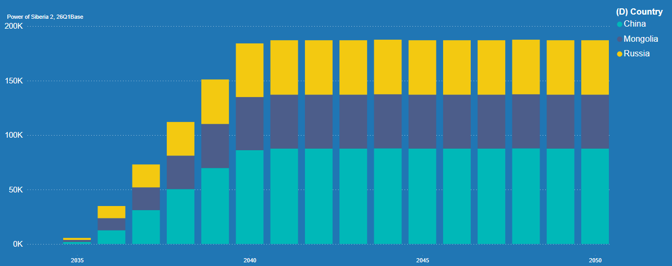
Power of Siberia 2 is different. Russia, China and Mongolia are reported to have signed a legally binding memorandum in 2025 for a 50 bcm/year route through Mongolia, including the Soyuz Vostok transit segment, but without pricing, investment terms and the start of deliveries resolved, the legally binding memorandum is not much more than paper. One CNPC researcher said the project would require “tremendous work” and could take eight to ten years. Currently, RBAC’s Base Case assumes a start of 2035, and that could change as the prices, volumes and timeline get closer to finalization.
Central Asia–China Gas Pipeline, Line D
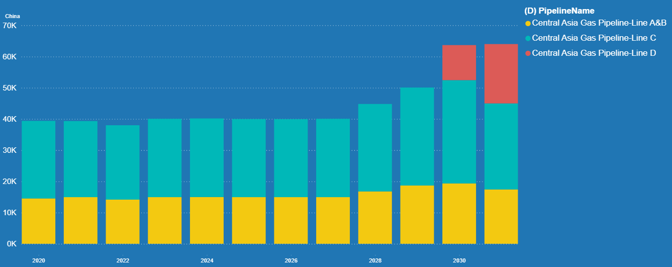
Line A, B and C together with a capacity of 55 bcm/year are currently transporting gas from Turkmenistan through Uzbekistan and Kazakhstan to Xinjiang, China. Line D is designed to deliver 30 bcm/year from Turkmenistan to western China via Uzbekistan, Tajikistan, and Kyrgyzstan, bypassing Kazakhstan. Upstream supply prospects were reinforced in April 2026 when Turkmenistan launched Phase 4 of the Galkynysh field expansion which is a $5.1 billion project under a CNPC turnkey contract to supply 10 bcm/year. However, the pipeline route itself remains stalled due to unresolved transit terms and long-term pricing agreements. Almost as massive as Power of Siberia 1, it illustrates the fact that China “has options.” The Central Asian region itself has its own fuel challenges domestically with the war in Ukraine reducing Russian energy capacity, and such shortages caused unrest in Kazakhstan in 2022, illustrating the risks in building pipelines through the region.
TAPI – South Asian Megaproject
The Turkmenistan, Afghanistan, Pakistan, India (TAPI) pipeline is still one of Asia’s biggest “what ifs.” At full design, it would move 33 bcm/year of Turkmen gas from Galkynysh to Afghanistan, Pakistan and India, with Pakistan and India intended to take roughly 47.5% each and Afghanistan about 5%. At 33 bcm/year, it is another megaproject that would be a huge boon for Turkmenistan, provide Pakistan and India with long-duration pipeline gas displacing some LNG or coal demand, and turn Afghanistan into a transit and local-gas market rather than a route risk. Afghanistan’s Ministry of Mines and Petroleum reported in July 2026 progress in Afghanistan border-to-Herat section: 101 km of pipeline had been laid, 126 km of corridor prepared, and 36 km buried underground on the Herat section.
Great for Afghanistan, but the larger project still faces familiar challenges; particularly, souring relations between the two anchor buyers, India and Pakistan, and difficult security conditions through southern Afghanistan, non-recognition of the Taliban by Western countries, complicating Western financing, not to mention unresolved downstream commercial commitments, tariff and cost agreements.
Without resolving those, TAPI would become a localized Turkmenistan–Afghanistan supply link under construction, rather than a South Asian mega-project, impacting international gas balances. Another possibility (more realistic) would be TAP. It could possibly be built to connect to Pakistan’s system and then add India later.
South America: The Very Alive Vaca Muerta
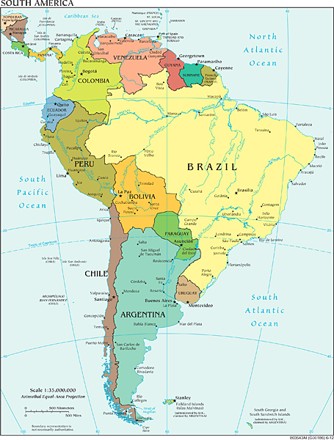
South America’s most important gas pipeline story is centered on Argentina. Venezuela making political headlines in January, has enormous resource potential, but meaningful growth will take time. Brazil has a large gas market and significant offshore resources. Petrobras’ Rota 3 pipeline is now fully operational, bringing up to 18 MMm³/d (~0.64 Bcf/d) of pre-salt gas from offshore fields to Brazil’s southeast coast. But the region’s biggest infrastructure story remains Vaca Muerta shale basin in western Argentina. RBAC first wrote about this in 2023 and recently revisited it.
South American Gas Markets at a Glance
Market | 2024 Consumption | Why it matters to this article |
Argentina | 45.6 bcm / ~4.4 Bcf/d | Largest gas market. |
Venezuela | 31.7 bcm / ~3.1 Bcf/d | Large consumer. |
Brazil | 31.4 bcm / ~3.0 Bcf/d | Large, hydro-sensitive market. |
Colombia | 13.4 bcm / ~1.3 Bcf/d | Tightening domestic supply. |
Peru | 11.3 bcm / ~1.1 Bcf/d | A largely self-contained domestic/LNG system. |
Chile | 7.1 bcm / ~0.7 Bcf/d | Import-dependent market. |
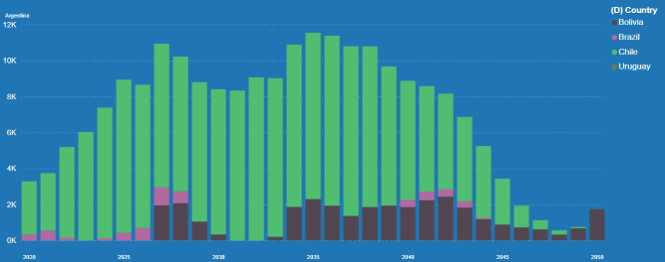
Argentina is expanding pipeline capacity east toward Buenos Aires, west across the Andes into Chile, north toward Bolivia and potentially Brazil, and southeast to the Atlantic coast for LNG exports. Even the reversal of the Gasoducto Norte pipeline, historically used to bring Bolivian gas south into Argentina, is now flowing north instead, through Bolivia to Brazil. Argentina is evolving into a regional supply hub, from a formerly majorly importing region. So, will all roads (pipelines) in South America eventually lead back to the Land of Silver? Let’s see.
Pipeline to Buenos Aires:
The Perito Francisco Pascasio Moreno Gas Pipeline carries natural gas from Vaca Muerta toward large gas demand centers around Buenos Aires. This pipeline expansion (expected Winter 2027) will increase capacity by 14 MMm³/d (~0.49 Bcf/d), raising throughput from 21 to 35 MMm³/d (~0.74 to ~1.24 Bcf/d), with an option to expand a further 6 MMm³/d (~0.21 Bcf/d) if future demand supports it.
RIGI (Régimen de Incentivo para Grandes Inversiones), Argentina's large-investment incentive program, providing qualifying projects with long-term tax, customs, foreign exchange, and regulatory stability benefits designed to attract major infrastructure and energy investments.
The project consists of three new compressor stations and an additional unit at Tratayén, the pipeline’s western origin as well as approximately 20 km of parallel pipeline and additional compression for incremental volumes beyond the pipeline’s terminus further into Greater Buenos Aires and northern Argentina. By allowing more Vaca Muerta production to reach Argentina’s largest population and industrial centers, it should further reduce seasonal LNG and liquid-fuel imports while supporting continued growth in shale gas production and is RIGI approved.
Pipeline to Southern Energy FLNG
The San Matías Pipeline is a proposed dedicated 470 km (292 mile) export pipeline that would carry Vaca Muerta natural gas to the Atlantic coast at San Antonio Oeste, with a capacity of 28 MMm³/d (~0.99 Bcf/d).
The pipeline will supply Southern Energy’s floating LNG (FLNG) export project, which has already reached final investment decision (FID) and is expected to have total liquefaction capacity of approximately 6 MTPA (~1.0 Bcf/d of feedgas) across two vessels. Harbour Energy expects the first vessel, Hilli Episeyo, to begin operations around year-end 2027, followed by the second vessel, MK II, around year-end 2028.
San Matías is the most commercially advanced greenfield Vaca Muerta-to-LNG pipeline currently under development, with RIGI approval granted, and EPC contracts for the pipeline and associated compression already awarded, it represents one of the clearest paths for Vaca Muerta gas to reach international LNG markets.
Pipeline to Argentina LNG:
The Argentina LNG (not yet named) pipeline will bring Vaca Muerta gas over 527 kms (327 miles) to the Argentina LNG’s FLNG units at Sierra Grande on the Atlantic coast at Sierra Grande. Developed by YPF, Eni, and XRG, the initial phase consists of two FLNG units with a combined liquefaction capacity of 12 MTPA. The two vessels would require ~18 bcm/year of feedgas (~1.7 Bcf/d) for the first phase.
This is the largest proposed gas transportation project currently tied to Vaca Muerta. The project submitted its RIGI application in August 2026, and the partners are targeting a final investment decision by year-end 2026.
South America’s Future
With all the above, there is yet more in the works for Vaca Muerta. In 2026, Argentina and Brazil did a study to create a roadmap for further integration, evaluating future routes through Bolivia, Paraguay, Uruguay and a direct connection between Argentina and Brazil, and concluded that more takeaway infrastructure will be needed.
Africa: One Grounded Domestic Project and Two Giant Regional Bets
AKK Pipeline
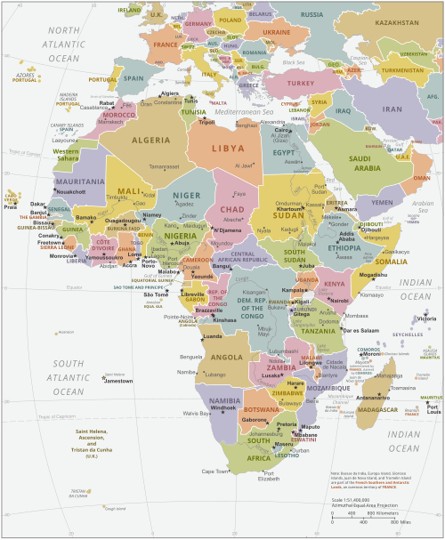
The 614-km, $2.8 billion Ajaokuta–Kaduna–Kano (AKK) pipeline, led by NNPC, is designed to move ~2.2 Bcf/d of gas from southern production regions into northern Nigeria for power generation, fertilizer and gas-based industry. The project has now reached Abuja, after overcoming challenges crossing the River Niger, where it will supply the planned 1,350 MW Abuja IPP and its fast expanding CNG network through its Mother Stations (high-capacity processing and distribution hub). The corridor is on a staged path rather than a single commissioning event.
AKK is part of the greater Trans-Nigeria Gas Pipeline (TNGP) which is itself part of the ambitions Trans-Saharan Gas Pipeline (TSGP). the AKK Pipeline is more important than it first looks.
Trans-Saharan Gas Pipeline (TSGP)
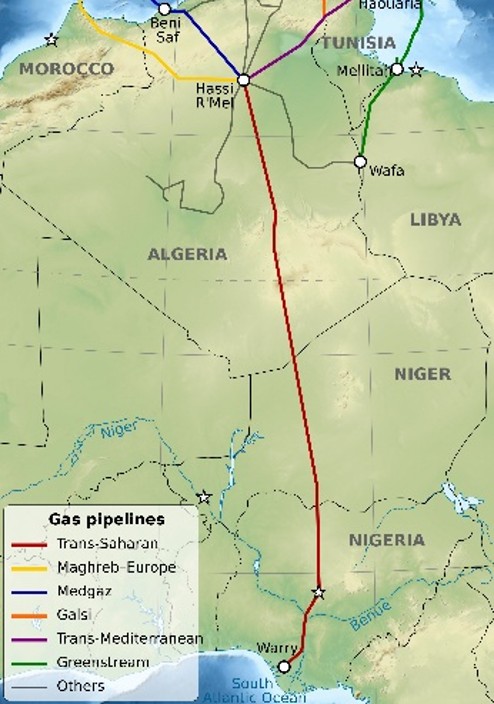
The Trans-Saharan Gas Pipeline (TSGP) is definitely the dark horse in the lineup. It was first proposed in the 1970s. Real progress may have been made with in June 2026, when Algeria’s Sonatrach officially launched construction work on the Algerian segment of pipeline. The full 4,128-km pipeline would transport up to 30 bcm/year of Nigerian gas through Niger to Algeria’s Mediterranean coast for export to Europe. However, ensuring secure transit through Niger and locking in international financing are the major hurdles to overcome, even as northern (and southern) segment construction begins.
African Atlantic Gas Pipeline (AAGP)
The proposed 6,900-km megaproject would be the world’s longest offshore pipeline from Nigeria to Morocco. It would move 30 bcm/year across 13 West African coastal states to Morocco and potentially Europe, with capacity designed for 15 bcm/year serving West African domestic markets, and 15 bcm/year transported to Europe via the Maghreb–Europe pipeline. In July 2026 at the Economic Community of West African States (ECOWAS) summit, leaders signed a treaty approving the legal framework for the project.
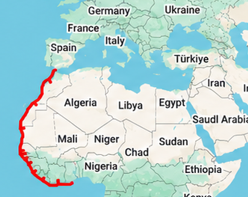
The project needs $25 billion in financing as well as binding shipper or offtake commitments. It has a few hurdles yet to overcome.
But if either of the projects moves forward, what would 15 to 30 bcm/year of natural gas to Europe (~4.5-9% of consumption) mean for prices? The answer depends on several factors: When will the pipeline begin deliveries? What other projects are competing with it? and How has demand changed by then?
These projects could reshape regional trade, but only if financing, transit security and firm contracts catch up with their ambition.
Conclusion
Across Parts 1 (where we covered North America and Europe) and here in Part 2, we have focused on the pipelines most likely to substantially impact how natural gas reaches the market either regionally or globally.
A common denominator is that these pipelines are making gas reserves more available: Permian takeaway, Vaca Muerta pipelines in every direction, better connection and integration of Black Sea and Caspian supply, or replacing expensive imported fuels with domestic gas.
So, what we called Category 1, the commercially grounded pipelines, such as Blackcomb, Rio Bravo, Coastal GasLink, AKK, Perito Moreno, Rota 3 and Saudi Arabia’s Master Gas System can be given more weight than the geopolitical megaprojects that dominate headlines. Their market effects can be modeled through changes in production, transportation, LNG feedgas, regional prices, imports and fuel displacement.
The Category 2 diversification pipelines are also prominent, particularly in Europe, such as TAP and IGB, Tuzla–Podișor and BRUA are valuable because they improve route diversity and regional balancing.
Category 3’s Power of Siberia 2, TAPI, the AAGP and TSGP pipelines should remain on every analyst’s watch list, but they require, like any prosecution, the burden of proof. Memoranda and feasibility studies are nice; political endorsement and publicity photos are fine, but nothing is particularly interesting until we have agreed-upon pricing, financing locked in and contracted gas.
Energy market modeling helps put all this into context by allowing you to test how pipeline timing, competing supply, demand and infrastructure changes interact in the global natural gas market. RBAC’s G2M2® Market Simulator for Global Gas and LNG™ is designed for exactly that purpose. To discuss a scenario or schedule a free demonstration, contact RBAC.
RBAC, Inc. has been the leading provider of market fundamental analysis tools used by the energy industry and related government agencies for over two decades. The GPCM® Market Simulator for North American Gas and LNG™ is the most widely used natural gas market modeling system in North America. RBAC’s G2M2® Market Simulator for Global Gas and LNG™ helps users understand evolving global gas and LNG dynamics and the interrelationship between North American and global gas markets.